
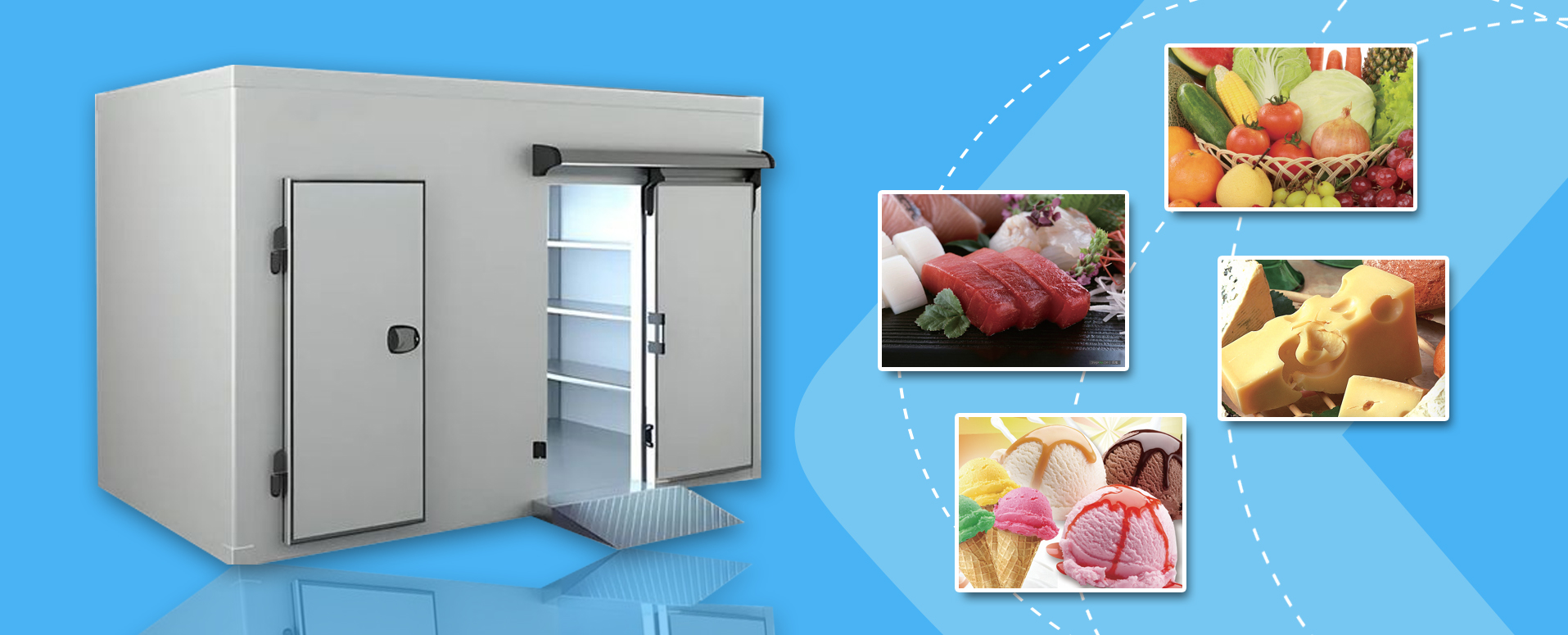

Ambient Storage (15°C to 25°C)
Ambient Storage (15°C to 25°C)
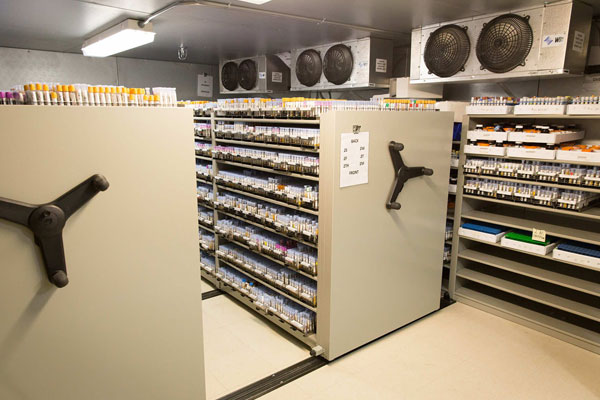
Refrigerated Room (2°C to 8°C)
Refrigerated Room (2°C to 8°C)

Freezer Room (-15°C to -25°C)
Freezer Room (-15°C to -25°C)
Stores products that need freezing, like some vaccines and biologics. It ensures long-term preservation and has strong insulation and safety systems.

Diverse Storage
Diverse Storage
Comprehensive FAQ: Pharmaceutical Cold Storage & GSP Compliance
Q1: How is a Pharmaceutical Cold Room different from a standard food cold store?
A: While both use refrigeration, the standards for pharmaceutical storage are significantly higher:
-
Precision: Pharma rooms require tighter temperature tolerances (typically ±2°C or ±3°C), whereas food can tolerate wider fluctuations.
-
Redundancy: It is almost mandatory for pharma rooms to have "Dual Redundancy" (backup refrigeration units and backup power), which is not always required for food.
-
Cleanliness: Materials must be non-shedding, dust-free, and easy to sanitize to meet GMP (Good Manufacturing Practice) standards.
-
Data Integrity: Temperature records must be unalterable and stored for 5+ years to comply with regulations like FDA 21 CFR Part 11.
-
Humidity Control: Many drugs are sensitive to moisture; therefore, pharma rooms often require humidity monitoring (35% - 75% RH), which is less common in general food freezers.
Q2: What are the standard temperature ranges for pharmaceutical storage?
A: The industry generally classifies storage into these zones:
-
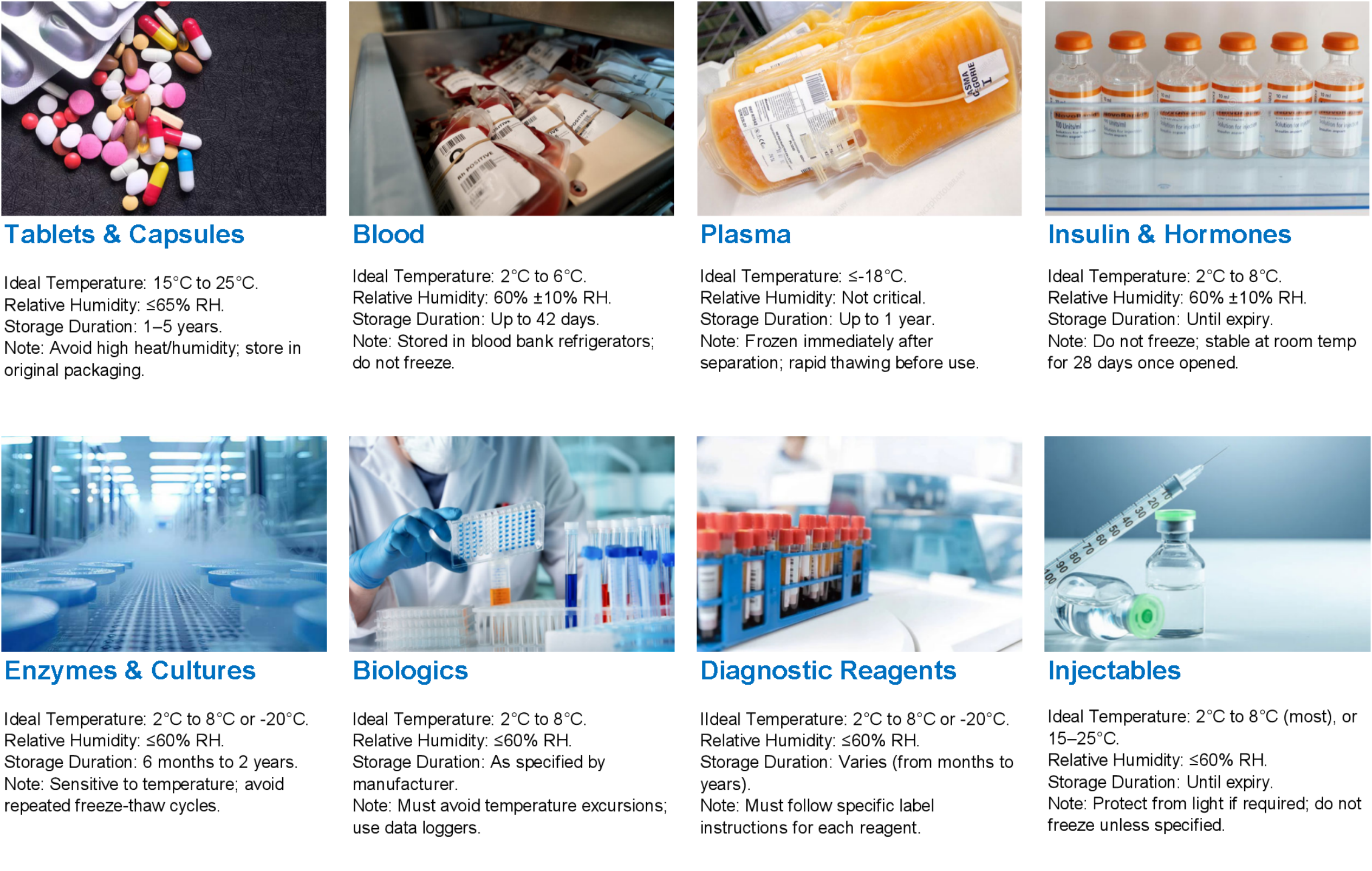
Cold Storage (The most common): 2°C to 8°C (36°F to 46°F). Used for insulin, vaccines, blood products, and many liquid injectables.
-
Cool Storage: 8°C to 15°C (46°F to 59°F).
-
Controlled Room Temperature (CRT): 15°C to 25°C (59°F to 77°F). Used for general tablets, capsules, and syrups. While this sounds like "room temperature," it requires an insulated room with HVAC to prevent overheating in summer or freezing in winter.
-
Frozen Storage: -10°C to -25°C. Used for plasma and certain enzymes.
Q3: What is "GSP" and how does it relate to cold storage?
A: GSP (Good Supply Practice) refers to the quality management regulations for the distribution of pharmaceutical products.
In the context of cold storage, GSP dictates:
-
The design and layout of the warehouse.
-
The calibration of instruments.
-
The requirement for an automatic alarm system.
-
The necessity of a backup power supply.
-
The obligation to perform continuous temperature monitoring and mapping.
Q4: What are the requirements for the insulation panels (PU Panels)?
A: The envelope of the room determines its thermal efficiency.
-
Material: Polyurethane (PU) sandwich panels are standard.
-
Surface: The panel surface should be pre-painted galvanized iron (PPGI) or Stainless Steel (304). For pharma, the coating must be "food-safe," anti-static, and resistant to harsh cleaning chemicals.
-
Fire Rating: Panels must meet B1 or B2 fire safety standards (flame retardant).
-
Cleanliness: The connection between walls and floors should use curved covings (radius corners). This eliminates 90-degree sharp corners where dust and bacteria accumulate, making cleaning easier.
Q5: Why is a "Dual Refrigeration System" (1+1 Redundancy) mandatory?
A: Mechanical failure is inevitable. In a pharma cold room holding millions of dollars worth of medicine, downtime is not an option.
-
Configuration: The system consists of two independent condensing units and two independent evaporators.
-
Operation: They usually operate on a Lead/Lag or Run/Standby cycle. Unit A runs for 12 hours, then Unit B runs for 12 hours.
-
Safety: If Unit A fails or goes into defrost, the control panel automatically activates Unit B immediately to ensure the temperature never spikes.
Q6: Do I need a specific type of floor?
A: Yes. Concrete creates dust, which violates GMP standards.
-
Epoxy Flooring: The standard for pharma cold rooms is a seamless, self-leveling epoxy floor. It is non-porous, dust-free, and easy to mop.
-
Insulation: For cold rooms (2-8°C), floor insulation is recommended to save energy. For freezers, it is mandatory to prevent frost heave.
Q7: What is "Thermal Mapping" and why is it required?
A: Thermal Mapping (Temperature Mapping) is the process of analyzing the temperature distribution within the room to ensure there are no "Hot Spots" or "Cold Spots."
-
The Process: Sensors are placed in a 3D grid throughout the room (top, middle, bottom corners, and center). The room is monitored for at least 24 to 48 hours.
-
Conditions: Mapping must be done in two states:
-
Empty State: Before loading products (OQ phase).
-
Full Load State: With products inside (PQ phase).
-
-
Frequency: GSP regulations typically require mapping:
-
Upon commissioning (new build).
-
Annually (or biannually) to account for Summer/Winter ambient changes.
-
Whenever significant modifications are made to the equipment or racking.
-
Q8: What are IQ, OQ, and PQ?
A: These are the three pillars of the Validation Master Plan:
-
IQ (Installation Qualification): Documented verification that the equipment (panels, compressor, controller) has been installed according to the design specs and manufacturer recommendations.
-
OQ (Operational Qualification): Verification that the system operates correctly. This includes testing alarms, testing the switch-over between backup units, and "Power Loss" tests.
-
PQ (Performance Qualification): Verification that the system maintains the required temperature (e.g., 2-8°C) under real-world conditions with actual product load over a set period.
Q9: Where should the permanent monitoring sensors be placed?
A: You cannot guess where to put them. The Thermal Mapping results dictate the placement.
-
One sensor should be placed at the "Hot Spot" (the warmest point found during mapping).
-
One sensor should be placed at the "Cold Spot" (the coldest point found during mapping).
-
This ensures that if the worst-case areas are safe, the rest of the room is safe.
Q10: What are the requirements for the Temperature Monitoring System (TMS)?
A: A pharma cold room must have an automated TMS that is independent of the refrigeration control system.
-
Sampling Rate: It must record data at least every 5 to 10 minutes.
-
Accuracy: Sensors usually require an accuracy of ±0.5°C.
-
Buffering: Sensors are often placed inside a bottle of glycol or glycerin. This buffers the sensor so it measures the product temperature, not just the fleeting air temperature (which changes when a door opens).
Q11: How should the alarm system function?
A: The system must provide Real-Time Alerts for:
-
High/Low Temperature: (e.g., >7.5°C or <2.5°C).
-
Power Failure: If the mains power cuts.
-
Door Open: If the door is left ajar for more than a set time (e.g., 5 mins).
-
Notification Methods: It must trigger a local siren/strobe light AND send remote notifications (SMS, Email, or App Push) to designated personnel (Warehouse Manager, Engineer).
Q12: What is "Data Integrity" and "21 CFR Part 11"?
A: This is a critical FDA and global standard. It means the temperature records must be:
-
Secure: Users cannot delete or fake the data.
-
Traceable: The system must record who logged in and if any settings were changed (Audit Trail).
-
If an inspector asks for temperature logs from 3 years ago, the system must be able to generate them exactly as they were recorded.
Q13: Can I store products directly on the floor?
A: No. This is a major GSP violation.
-
Airflow: Cold air must circulate under the product to maintain temperature.
-
Hygiene: Floors can be dirty or wet.
-
Rule: All products must be on pallets or shelves, raised at least 10cm off the floor, and kept at least 30cm away from the walls and ceiling lights.
Q14: How do I manage humidity in a pharma cold room?
A: High humidity can crush cardboard boxes and encourage mold. Low humidity can dry out rubber stoppers.
-
Control: In humid climates, the cold room typically needs a Dehumidifier. In very dry climates, a Humidifier might be needed.
-
Range: The standard requirement is usually between 35% and 75% Relative Humidity (RH) unless the drug packaging specifies otherwise.
Q15: What is the procedure for "Pre-Conditioning"?
A: You should never load warm products into a cold room, nor should you turn on a warm room and immediately load it.
-
Protocol: Turn on the cold room and let it run empty until it stabilizes at 5°C for a few hours. Only then should you load the pharmaceutical products. This prevents a temperature spike that could trigger alarms.
Q16: What happens if there is a blackout (Power Outage)?
-
UPS (Uninterruptible Power Supply): The temperature monitoring system and control panel should be on a UPS so they keep recording data and sending alarms even when mains power dies.
-
Backup Generator: The facility must have a diesel generator with an ATS (Automatic Transfer Switch). It should kick in within 30-60 seconds of a power failure to power the refrigeration units.
-
Thermal Inertia: A well-insulated PU panel room can hold temperature for a few hours if the door remains closed. Do not open the door during an outage.
Q17: What is the maintenance schedule for a pharma cold room?
-
Daily: Check current temperature, check for active alarms, inspect floor for water/ice.
-
Monthly: Clean the condenser fins (dust reduces efficiency), clean the evaporator coils, check door seals (gaskets) for cracks.
-
Annually:
-
Calibration: A certified 3rd party must calibrate all sensors (NIST traceable).
-
Validation: Re-run thermal mapping if required by local laws (e.g., Summer mapping).
-
Service: HVAC technician to check refrigerant levels and compressor oil.
-
Q18: What is a "Temperature Excursion"?
A: An excursion is any event where the temperature deviates outside the recommended range (e.g., rising to 9°C for 20 minutes).
-
Action:
-
Quarantine the affected stock (do not sell it).
-
Download the data logs.
-
Contact the drug manufacturer with the data. Ask: "Is the product still safe after 20 mins at 9°C?"
-
Document the incident and the "Corrective and Preventive Action" (CAPA).
-
Q19: What is the difference between a "Cold Room" and a "Stability Chamber"?
-
Cold Room: Used for storage and distribution. It holds stock before it is sold.
-
Stability Chamber: Used for R&D and Quality Control. It tests how drugs react over time at specific conditions (e.g., exactly 25°C / 60% RH). Stability chambers are much smaller and have extremely precise control (±0.5°C / ±3% RH).
Q20: What are "Phase Change Materials" (PCM) and are they used in cold rooms?
A: PCMs are materials that freeze/melt at specific temperatures (e.g., 5°C).
While mostly used in transport boxes (passive cooling), some advanced cold rooms use PCM tanks as a "Thermal Battery." If power fails, the PCM tank releases stored cold energy to keep the room cool for longer periods, acting as a non-electric backup.
Glossary of Terms
-
HVAC: Heating, Ventilation, and Air Conditioning.
-
NTC/PT100: Types of temperature sensors (Thermistors/Resistance Thermometers).
-
BMS: Building Management System.
-
Quarantine Area: A physically separated area (often a cage) inside the cold room for damaged, expired, or returned goods.
-
Defrost Cycle: The periodic melting of ice off the evaporator coils. During this short time, air temperature may rise slightly, but product temperature should remain stable.
Data da postagem:Sep-25-2020
