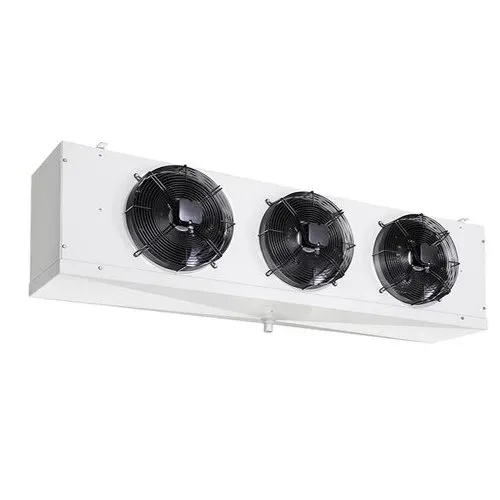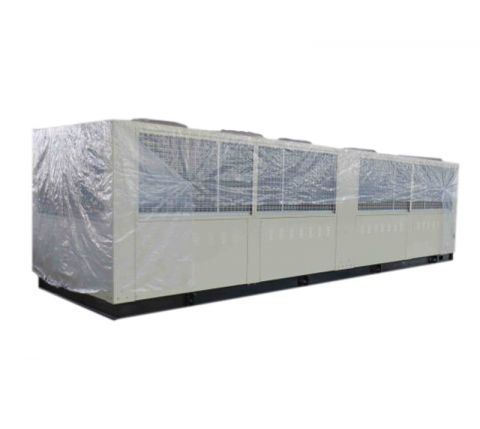


CW(R)FM930 Air-cooled Screw Chillers (Heating Units)
Description of Air-Cooled Screw Chillers (Heat Pumps)

Cooling Mode: The compressor compresses the refrigerant into a high-temperature, high-pressure gas. Heat is then dissipated into the atmosphere via the air-cooled condenser (fins + fan). After liquefaction, the refrigerant passes through the expansion valve into the water-side evaporator, where it absorbs heat from the water. This produces chilled water at approximately 7°C for supply to indoor terminals.
Heating Mode (Heat Pump Type): The system reverses direction via the four-way valve, absorbing heat from the outdoor air (even in low-temperature environments) to provide 45°C to 50°C hot water to indoor spaces.
Characteristics of Air-Cooled Screw Chillers (Heat Pumps)

Structural and Installation Characteristics
Integrated design, no plant room required:
The unit incorporates its own condenser fan and is installed directly outdoors (on rooftops, ground level, or podium decks).
Characteristics: Eliminates the need for costly indoor plant room space, significantly reducing civil engineering investment costs.
No cooling water system required:
Characteristics: Eliminates the need for cooling towers, cooling water pumps, make-up water tanks, and complex cooling water pipework. This is crucial for water-scarce regions or areas where cooling tower ‘drift’ and noise are prohibited (e.g., hospitals with strict Legionella control protocols, premium office buildings).

Performance and Operational Characteristics
Stepless Capacity Control:
This represents the most significant advantage of screw compressors over piston compressors or fixed-frequency scroll compressors.
Characteristics: Through slide valve regulation, the unit achieves continuous capacity adjustment from 10% to 100%.
Value: When indoor loads fluctuate slightly, the compressor precisely matches output, ensuring highly stable water temperature control (fluctuations kept within ±0.5°C) while avoiding grid impacts caused by frequent compressor starts and stops.

Maintenance and economic characteristics
Maintenance is exceptionally straightforward:
Characteristics: With no water cooling system, users need not concern themselves with cooling tower cleaning, water treatment, pipe descaling, or winter pipe freeze protection.
Value: Significantly reduces long-term operational labour costs and consumables expenditure.
Coefficient of Performance (COP) characteristics:
Characteristics: The full-load COP of air-cooled units (typically 3.0–3.4) is lower than that of water-cooled units (typically 5.0–6.0).

Environmental protection and low-noise characteristics
Low-noise fan system:
Features large-impeller, low-speed axial fans.
Bionic blade design (e.g., serrated trailing edges) significantly reduces vortex noise.
Motors typically possess IP54 or higher protection ratings, suitable for harsh outdoor weather conditions.
Refrigerant Selection:
Current mainstream products are fully compatible with environmentally friendly refrigerants, such as R134a (low-pressure refrigerant, high safety), R410A (high-pressure refrigerant, compact size and high efficiency), or R407C.

· PrFood processing workshops
· Cold stores and freezer rooms
· Cold chain logistics centres and distribution warehouses
· Pharmaceutical factories and cleanrooms
· Biological laboratories and sample repositories
· Flower preservation chambers
· Low-temperature storage for

| Model | CW(R)FM930 | Condensing power(kw) | 2.2x20 |
|
Refrigeration capacity(kw) |
931.8 | Evaporator flow rate(m3/h) | 160.3 |
| Heating capacity(KW) | 969.8 |
Evaporator water(kpa) |
40-80 |
| Total power(KW) | 303.6 |
Evaporator connection pipe specifications |
4DN125 |
| Power supply | 3N/380V/50HZ |
Refrigerant |
R22 |
| Compressor model | Semi-hermetic twin-screw compressor |
Refrigerant charge(kg) |
410 |
| Compressor Starting Method | 25% (33%) load + star-delta voltage reduction starting |
Length(mm) |
13000 |
| Compressor input power(KW) | 259.6 |
Width(mm) |
2350(Includes lifting blocks, excludes lifting blocks 2200) |
| Compressor operating current(A) | 440.6 |
Height(mm) |
2580 |
| Condenser model |
Copper tube and aluminium fin heat exchanger |
Net weight(kg) | 10900 |
|
Condenser Fan Model |
Low-noise axial-flow fan | Operating weight(kg) | 11400 |
|
Condenser airflow(m3/h) |
480000 |
|
|
Comprehensive FAQ: Air-Cooled Screw Chiller & Heat Pump Units
Part 1: General Technology & Operating Principles
1. What exactly is an Air-Cooled Screw Chiller, and how does it differ from other chillers?
An Air-Cooled Screw Chiller is a large central air conditioning system that produces chilled water for industrial processes or building climatization. It is defined by two main characteristics:
-
Compressor Type: It uses a rotary screw compressor (as opposed to a scroll, centrifugal, or reciprocating compressor). Screw compressors are known for durability and their ability to handle large capacities (typically 70 kW to 500+ kW).
-
Heat Rejection: It rejects heat into the atmosphere using air-cooled condenser coils and fans, rather than using a cooling tower and water loop (which is how water-cooled chillers work).
2. Can these units provide heating as well as cooling?
Yes. If the unit is specified as a Heat Pump, it is equipped with a 4-way reversing valve.
-
Cooling Mode: The unit functions normally, absorbing heat from the building water loop and rejecting it outside via the air fans.
-
Heating Mode: The cycle reverses. The refrigerant absorbs heat from the outside air (even at low temperatures) and rejects that heat into the water loop, providing hot water for the building. This makes the system versatile for year-round climate control.
3. Why choose a Screw Compressor over a Scroll or Centrifugal Compressor?
Selection depends largely on capacity and load profile:
-
Vs. Scroll: Scroll compressors are generally limited to smaller capacities (under 100 tons/350 kW). For larger buildings, you would need manifolds of many scrolls, which increases complexity. A single screw compressor handles much higher loads.
-
Vs. Centrifugal: Centrifugal chillers are efficient at full load and very large capacities (over 500 tons), but they are prone to "surge" at low loads. Screw compressors are positive displacement machines, meaning they are very stable and efficient at part-load conditions (e.g., when the building is only 40% occupied).
4. How does the "slide valve" capacity control work in a screw compressor?
The slide valve is a critical component for efficiency. It is a movable section of the compressor housing that slides along the rotors.
-
Function: By moving the valve, the effective length of the rotors is changed. This alters the volume of refrigerant being compressed.
-
Benefit: This allows the compressor to modulate its capacity steplessly (continuously) from 100% down to 10% or 25%. This prevents the compressor from frequently cycling on and off (which wastes energy and damages the motor) and matches the energy output exactly to the building's demand.
5. What is the difference between an Air-Cooled and a Water-Cooled Screw Chiller?
-
Air-Cooled: A "packaged" unit typically installed on the roof or ground. It uses fans to blow air over coils to remove heat. It is easier to install and requires less maintenance because it does not require a cooling tower, condenser pumps, or chemical water treatment for a tower.
-
Water-Cooled: Installed indoors and connected to an outdoor cooling tower. They are generally more energy-efficient (lower condensing temperatures) but have higher installation costs and consume significant amounts of water via evaporation.
Part 2: Efficiency & Performance
6. What do EER, COP, and IPLV mean, and which is most important?
-
EER (Energy Efficiency Ratio): The ratio of cooling capacity (Btu/h) to power input (Watts) at full load.
-
COP (Coefficient of Performance): Similar to EER but unitless (W/W). Used for both heating and cooling efficiency.
-
IPLV (Integrated Part Load Value): This is arguably the most important metric for screw chillers. Since chillers rarely run at 100% capacity (mostly running at 50-75%), IPLV calculates the weighted average efficiency at various load points (100%, 75%, 50%, 25%). A high IPLV indicates the unit will save money in real-world operating conditions.
7. How does a Variable Frequency Drive (VFD) affect the screw chiller's performance?
A VFD (or VSD) varies the speed of the compressor motor based on the load.
-
Without VFD: The motor runs at constant speed, and the slide valve manages capacity. This is less efficient at low loads.
-
With VFD: The motor slows down when demand is low. Since power consumption drops according to the cube law of fan/pump affinity laws, slowing the motor results in massive energy savings. A VFD screw chiller can offer 20-30% higher efficiency than a standard unit at part-load.
8. What is a "Desuperheater" or Heat Recovery option?
This is an energy-saving feature often available on screw chillers.
-
How it works: A small heat exchanger is placed at the compressor discharge. Before the hot refrigerant goes to the condenser coils to be wasted into the air, it passes through this exchanger.
-
Benefit: It captures "free" waste heat to produce hot water (up to 55°C-60°C) for domestic use, boiler pre-heating, or reheating for humidity control, while simultaneously improving the chiller's cooling efficiency.
9. Can air-cooled screw chillers operate in extreme ambient temperatures?
-
High Heat: Standard units operate up to roughly 43°C (110°F). For desert regions or industrial rooftops, "High Ambient" kits are required, allowing operation up to 52°C or 55°C, usually by using larger condenser coils and stronger fans.
-
Freezing Cold: If the unit is used for cooling in winter (e.g., for a data center), it requires "Low Ambient Control" (fan speed modulation) to prevent head pressure from dropping too low. If used as a heat pump, efficiency drops as the air gets colder, usually requiring backup heating below -10°C or -15°C unless specifically designed for low-temperature heating.
Part 3: Installation & Application
10. What are the space and airflow requirements for installation?
Air-cooled units rely entirely on airflow.
-
Clearance: You typically need at least 1.5 to 2 meters (5-6 feet) of clear space around the unit to ensure proper air intake.
-
Recirculation: If units are placed too close to walls or each other, the hot air discharged by the fans can be sucked back into the intake (short-cycling). This causes high pressure alarms and drastically reduces efficiency. Never install these units indoors or under a low roof without ducting.
11. Is a Buffer Tank necessary for the water loop?
A buffer tank is a storage vessel that increases the volume of water in the system.
-
Necessity: It is highly recommended if the water loop volume is small. Screw compressors need a minimum run time to lubricate properly and avoid overheating the motor.
-
Function: If the building load drops suddenly, the buffer tank prevents the water temperature from changing too fast, allowing the chiller to ramp down smoothly rather than shutting off on a "low water temperature" safety alarm.
12. How loud are air-cooled screw chillers, and can noise be mitigated?
They can be noisy, typically ranging from 75 to 95 dBA, due to the screw compressor whine and fan noise.
-
Mitigation:
-
Compressor Sound Jackets: Acoustic blankets wrapped around the compressor can drop noise by 3-5 dB.
-
Low Noise Fans: Using larger, slower-spinning fans with composite blades.
-
Night Mode: The controller limits fan speed at night to reduce noise when cooling demand is lower.
-
13. Why is Glycol (Anti-freeze) required?
Since the evaporator (where water is cooled) is located outdoors within the unit casing:
-
Risk: If the ambient temperature drops below freezing and the pumps stop (e.g., power failure), the water inside the evaporator can freeze. Water expands when freezing, which will burst the copper tubes, destroying the chiller.
-
Solution: A percentage of Ethylene or Propylene Glycol is added to the water loop to lower the freezing point. Alternatively, electric heat tape and running the pumps continuously can be used, but glycol is the safest passive protection.
Part 4: Maintenance & Lifecycle
14. What is the most critical maintenance task for an air-cooled unit?
Cleaning the Condenser Coils.
-
Why: The coils are exposed to outside air, pollen, dust, leaves, and pollution. If the coils get dirty, the unit cannot reject heat.
-
Consequence: This leads to higher condensing pressure, which increases electricity usage significantly (1°C rise in condensing temp = ~3% increase in energy). Eventually, it causes "High Pressure" trips. Coils should be washed at least once per quarter, or more in dusty environments.
15. How often should the compressor oil be changed?
Unlike a car, you do not necessarily change the oil on a fixed schedule (e.g., every year).
-
Best Practice: Perform an Oil Analysis annually. Send a sample to a lab to check for acidity, moisture, and metal particulates.
-
Action: Only change the oil if the analysis indicates degradation. However, the oil filter should be changed regularly as per the manufacturer's manual (usually annually).
16. What refrigerants are currently used, and what about future regulations?
-
Standard: R134a (most common for screws) and R410A.
-
The Shift: Due to global warming regulations (like the Kigali Amendment), the industry is moving toward Low-GWP (Global Warming Potential) refrigerants.
-
Future: Look for units using R1234ze, R513A, or R32. R1234ze is becoming the standard for new screw chillers as it has near-zero GWP, though it is slightly flammable (A2L), requiring specific safety sensors.
17. What is the expected lifespan of an Air-Cooled Screw Chiller?
With proper maintenance, the mechanical life expectancy is 15 to 20 years.
-
Factors: Coastal environments (salt corrosion on coils) can reduce this to 10 years unless special "Blue Fin" or epoxy coatings are applied to the coils. Neglecting oil analysis or frequent short-cycling will also shorten the compressor life.
Part 5: Troubleshooting & Cost
18. What causes a "High Pressure" alarm?
This is the most common fault. It means the pressure in the condenser is too high.
-
Cause 1: Dirty condenser coils (restricted airflow).
-
Cause 2: Fan failure (broken belt, bad motor, or contactor).
-
Cause 3: High ambient temperature exceeding design limits.
-
Cause 4: Non-condensables (air) trapped inside the refrigerant circuit (requires purging).
19. What causes a "Low Pressure" alarm?
This usually indicates an issue in the evaporator or a lack of refrigerant.
-
Cause 1: Refrigerant leak (loss of charge).
-
Cause 2: Low water flow through the evaporator (clogged strainer, pump failure, or closed valves).
-
Cause 3: Expansion valve (EXV) failure sticking closed.
-
Cause 4: Low load condition without proper hot gas bypass or VFD control.
20. How does the initial cost compare to the operating cost?
-
CAPEX (Initial Cost): Air-cooled screw chillers are cheaper to buy and install than water-cooled systems because you don't need cooling towers, condenser pumps, or complex piping.
-
OPEX (Operating Cost): They consume more electricity per ton of cooling than water-cooled units.
-
The Verdict: For buildings where water is expensive, maintenance staff is limited, or the climate is moderate, the Air-Cooled Screw Chiller usually offers the best Total Cost of Ownership (TCO) balance.