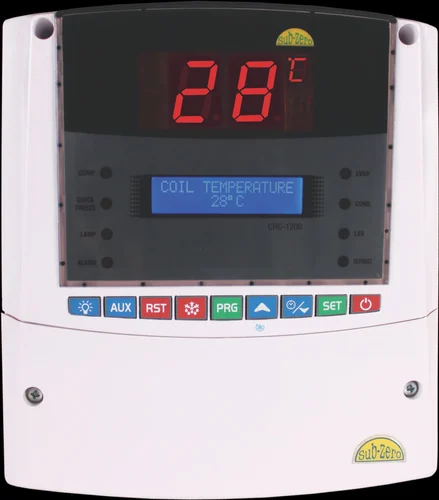
Refrigeration Defrosting ElectricControl Cabinet
Description of Refrigeration Defrosting ElectricControl Cabinet
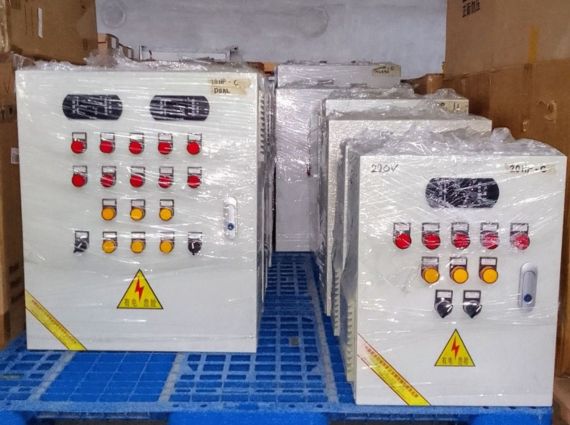
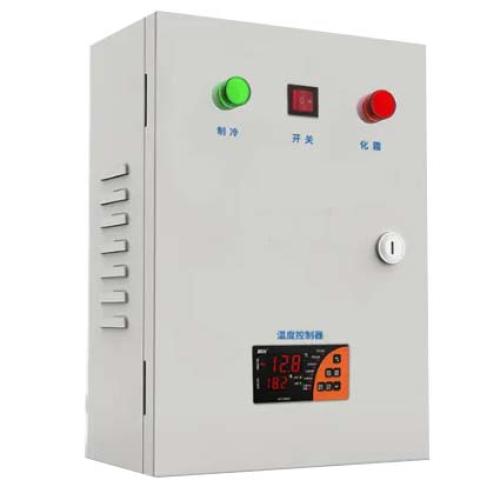
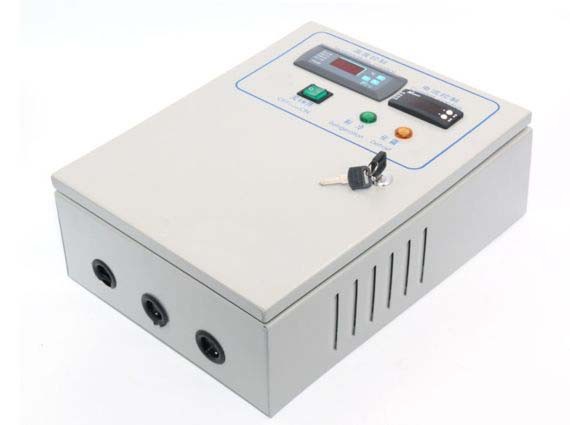
This Refrigeration Defrosting Electric Control Cabinet is an intelligent, heavy‑duty control unit purpose‑built for commercial cold rooms, freezers, chillers, and industrial refrigeration systems. It integrates precise temperature regulation, automatic/manual defrost management, fan control, and comprehensive electrical protection in one rugged enclosure, ensuring stable, efficient, and safe operation around the clock.
Designed for reliability and ease of use, it features an intuitive digital controller with clear temperature display and simple parameter setup. It supports timed defrost, temperature‑triggered defrost, and emergency manual defrost to eliminate frost buildup on evaporators, boost heat exchange efficiency, and cut energy consumption.
Core characteristics of Refrigeration Defrosting ElectricControl Cabinet
Intelligent Defrost Control
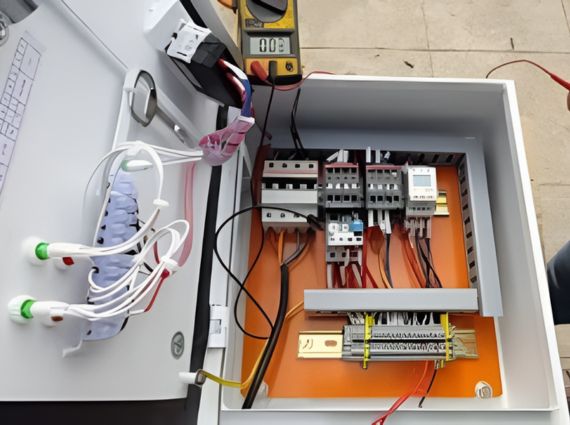
The cabinet supports multiple defrost modes including electric heating defrost, hot gas defrost, and timed defrost to match different system configurations. It uses dual sensors to monitor real-time cabinet temperature and evaporator coil conditions, enabling adaptive defrost scheduling based on actual frost buildup rather than fixed intervals. This eliminates unnecessary defrost cycles and reduces energy consumption while preventing excessive frost from blocking airflow and reducing cooling efficiency. The system automatically pauses evaporator fans during defrost to speed up frost melting and resumes cooling once the defrost termination temperature is reached, minimizing temperature fluctuations inside the storage space.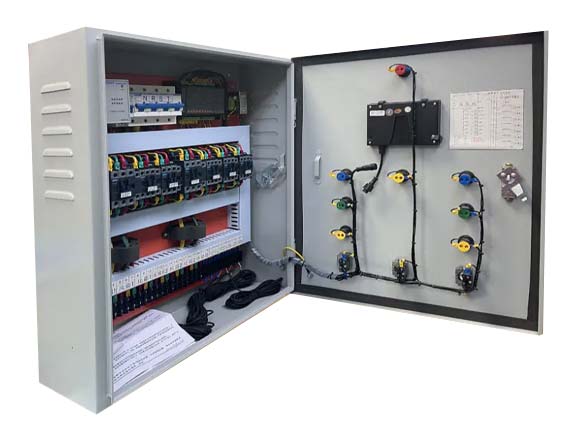
Precision Temperature Management
Equipped with a high precision digital controller, the cabinet maintains stable temperature control within a wide range suitable for both refrigeration and freezing applications. It supports customizable temperature setpoints, defrost duration, defrost intervals, and fan delay parameters to meet diverse storage requirements. The controller provides clear real time temperature display and allows easy parameter adjustment via intuitive push buttons or a touch panel. Stable temperature control preserves the quality, texture, and shelf life of perishables while supporting compliance with food safety and pharmaceutical storage standards.
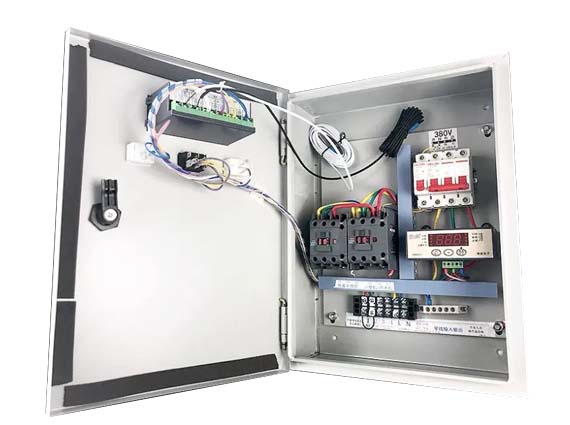
Comprehensive System Protection
The control cabinet integrates multiple safety features to safeguard compressors, fans, defrost heaters, and other critical components. These include compressor start delay protection, overload protection, overcurrent protection, phase loss and phase sequence protection, high and low pressure protection, and sensor fault detection. These protective functions prevent damage from power instability, blocked coils, improper operation, or component failure, reducing downtime and maintenance costs. Automatic fault diagnosis provides clear alarm codes or messages for quick troubleshooting.
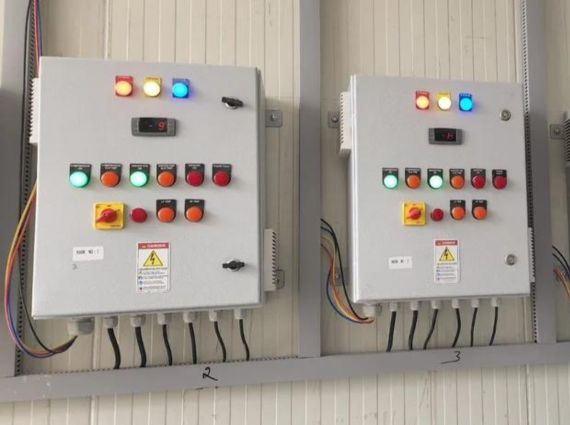
Structural and Electrical Features
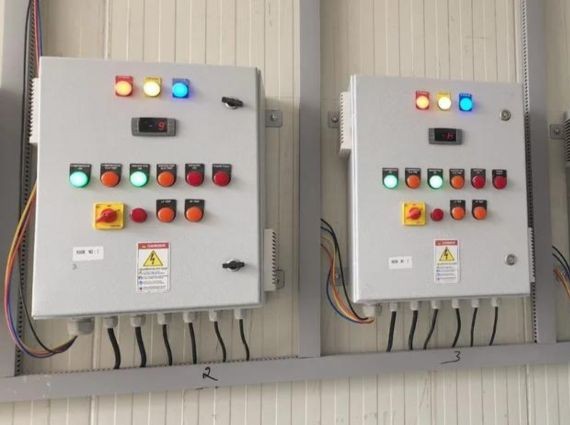
The cabinet is built with a rugged metal enclosure for durability and corrosion resistance, suitable for humid and low temperature refrigeration environments. Wiring follows international electrical standards with clearly labeled terminals for simplified installation and maintenance. Internal components use branded contactors, relays, and circuit breakers for long term reliability. The design supports both single phase and three phase power supplies with wide voltage compatibility to adapt to different grid conditions. Cable glands and sealed wiring provide dust and moisture protection, enhancing stability in harsh working environments.
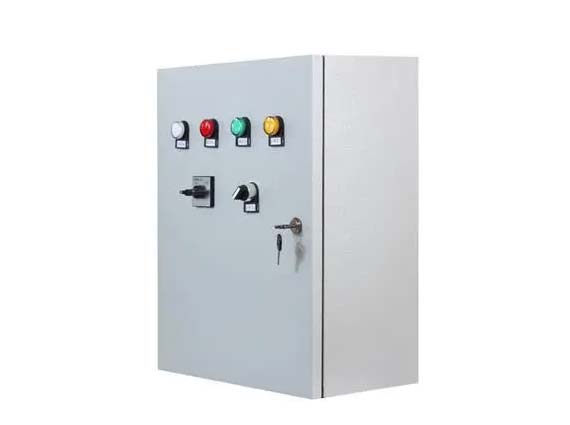
· PrFood processing workshops
· Cold stores and freezer rooms
· Cold chain logistics centres and distribution warehouses
· Pharmaceutical factories and cleanrooms
· Biological laboratories and sample repositories
· Flower preservation chambers
· Low-temperature storage for
|
Product Type |
Cold Room Control Panel board |
| Power Supply | 380VAC,50/60Hz |
| Temperature Measurement Range | -50℃ to 50℃ |
| Temperature Control Range | -40℃℃ to 119℃ |
| Temperature Measurement Accuracy | +1℃ |
| Resolution | 0.1℃ |
| Contact Capacity (Compressor) | 14A, 21A,28A,35A,56A |
| Contact Capacity (Defrost) | 14A,21A,28A,35A,56A |
| Contact Capacity (Fan) | 7A |
| Sensor Type | NTC (10KQ/25°C, B-3435K) |
| Communication | RS-485 Network, wiFi (2.4GHz) |
| Compressor Delay Protection Time | 1-110 minutes (adjustable) |
Selector Switches for Cold Storage Panels: Comprehensive FAQ
Section 1: Functionality and Operational Logic
Q1: What is the specific role of a selector switch on an automatic cold storage control panel?
The selector switch serves as the critical human-machine interface (HMI) bridge between the operator and the cold storage automation system (usually a PLC or digital controller). Its primary function is to define the operational mode of the refrigeration equipment. Unlike a simple push-button that provides a momentary signal, a selector switch maintains a contact state, instructing the system to remain in a specific logic state—such as "Automatic," "Manual," "Off," or specific defrost modes—until physically changed by an operator. It ensures that the system behavior is deliberate and prevents accidental mode changes.
Q2: Why is the "Auto-Off-Manual" (H-O-A) configuration so common in cold storage panels?
The "Hand-Off-Auto" (HOA) or "Manual-Off-Auto" configuration is the industry standard for safety and maintenance protocols:
Auto: The system is controlled by sensors (thermostats) and the PLC. It cycles compressors and fans based on temperature demand. This is the normal operating state.
Off: The circuit is physically broken. The equipment will not run regardless of temperature rise. This is used for minor checks or shutting down a specific zone.
Manual (Hand): This bypasses the sensors and PLC logic, forcing the contactor to close and the equipment to run continuously. This is crucial for emergency cooling if the controller fails, or for testing the compressor performance during maintenance.
Q3: Can these switches be used to directly turn the compressor on and off?
generally, no, they should not be used to directly switch the main power line of a large compressor. These switches are typically rated for "Control Circuit" (Pilot Duty) applications. They switch the low-current signal (e.g., 24V DC or 220V AC control voltage) that energizes the electromagnetic coil of a Contactor. The Contactor then handles the high-amperage load of the compressor. While some heavy-duty cam switches exist that can handle motor loads (AC-3 category), in modern automated cold storage panels, the selector switch is almost exclusively a control device to protect the operator and the switch mechanism.
Q4: What is the difference between a "Maintained" and a "Spring-Return" selector switch in this context?
Maintained (Latching): When you turn the knob to a position (e.g., "Defrost"), it stays there until you turn it back. This is used for setting operating modes (Auto/Manual) that need to stay active for hours or days.
Spring-Return (Momentary): When you let go of the knob, it snaps back to the center or original position. This is often used for "Reset" functions or to trigger a manual "Pump Down" cycle where the operator must be present holding the switch to perform the action, ensuring safety.
Q5: How does the switch handle the specific "Defrost" logic?
In many panels, a dedicated selector switch allows operators to force a "Manual Defrost." When switched to this position, the switch sends a signal to the controller to override the timer, immediately shutting off the solenoid valve and turning on the electric heater elements or reversing the valve (for hot gas defrost). This is essential when operators visually identify excessive ice buildup on the evaporator coils that the automatic sensors may have missed or if the door was left open too long.
Section 2: Environmental Durability & Material Science
Q6: Why can’t I use a standard household switch for a cold storage panel?
Standard switches are not engineered for the thermal stress of cold storage environments. The primary failure points for standard switches in cold environments are:
Lubricant Freezing: The internal grease in standard switches solidifies at low temperatures, causing the mechanism to seize or become incredibly stiff.
Plastic Embrittlement: Standard plastics undergo a "glass transition" and become brittle, shattering when turned forcefully.
Condensation: They lack the sealing gaskets required to prevent moisture ingress, leading to short circuits.
Cold storage switches use low-temperature synthetic lubricants and reinforced engineering plastics (like high-grade Polycarbonate or Polyamide) to withstand these conditions.
Q7: What is the recommended IP (Ingress Protection) rating for these switches?
For cold storage control panels, the minimum recommended rating is IP65.
IP65: Dust-tight and protected against low-pressure water jets. This is necessary because control panels are often located in corridors or loading docks that undergo washdown procedures.
For panels located inside the cold room itself (which is rarer but happens), IP66 or IP67 is preferred to handle higher water pressure and potential ice formation on the panel face.
Q8: How does the switch design account for operators wearing thick thermal gloves?
Ergonomics are vital in cold chains. A "Long Handle" or "Lever" style actuator is preferred over a short "thumb grip" knob. The longer lever provides better leverage and visual indication of the switch position. Additionally, the spacing between switches on the panel should be increased (typically 50mm or more center-to-center) to prevent a gloved hand from accidentally bumping adjacent buttons while turning the switch.
Q9: Will condensation affect the electrical contacts inside the switch?
Condensation is a major threat. Even if the switch is sealed, temperature fluctuations can cause internal "breathing" where moist air enters and condenses. To combat this, high-quality cold storage switches use Silver-Nickel (AgNi) or Gold-plated contacts. These materials are resistant to oxidation and corrosion. Furthermore, the mechanical action of the switch often includes a "wiping" or "self-cleaning" friction movement that scrapes off any micro-corrosion every time the switch is actuated, ensuring a good electrical connection.
Q10: What is the operational temperature range for these switches?
A high-quality industrial selector switch for refrigeration applications typically boasts an operational temperature range of -25°C to +70°C (-13°F to +158°F). Specialized "Polar" versions can operate down to -40°C. It is crucial to verify that the switch is rated for the ambient temperature where the panel is located—often the panel is outside the freezer in a slightly warmer zone, but it must still withstand the cold drafts and conduction from the wall.
Section 3: Installation, Safety, and Maintenance
Q11: What is the standard mounting diameter for these switches?
The global industry standard for mounting industrial control switches is 22mm (specifically Ø22.3mm). This standardization allows for easy replacement. If a switch fails, you can swap it out with a spare from various manufacturers (like Schneider, ABB, Siemens, or specialized HVAC brands) without drilling new holes in the stainless steel control cabinet.
Q12: How are the contact blocks configured? Can I add more functions?
These switches are modular. The operator head (the knob) attaches to a mounting latch, which then holds the "Contact Blocks." You can stack these blocks.
NO (Normally Open): Used to start a circuit (e.g., turning "Auto" mode ON).
NC (Normally Closed): Used to break a circuit (e.g., the "Stop" or "Off" position).
For a cold storage panel, you might stack multiple blocks so that turning to "Manual" simultaneously turns on the compressor and activates a warning light.
Q13: Are there specific safety certifications required?
Yes. In addition to standard electrical safety marks (like CE in Europe or UL/CSA in North America), the materials should be RoHS compliant (free of hazardous substances). Crucially, the plastic housing must be Flame Retardant (V0 rating). In the event of an electrical short inside the panel, the switch material must self-extinguish and not contribute to the fire, which is a critical safety parameter in insulated cold storage warehouses where fire spreads rapidly.
Q14: How do I identify if a selector switch is failing?
Common signs of failure include:
"Mushy" feel: The distinct "click" (detent) is gone, indicating the internal springs or cams are worn or the grease has degraded.
Intermittent Operation: You have to wiggle the switch in the "Auto" position to get the compressor to start. This indicates contact oxidation or loose terminals.
Heat: If the back of the switch feels hot, the contacts are resisting current flow, creating a fire hazard.
Q15: Can I wash the control panel with a high-pressure hose?
Even if the switch is rated IP65/IP66, direct high-pressure jetting (power washing) at close range is discouraged. High pressure can force water past even the best seals over time, especially if the rubber gaskets have aged and hardened in the cold environment. It is recommended to wipe down the panel face with a damp cloth and mild detergent, or use low-pressure spray, ensuring the seal integrity is not compromised.
Section 4: Advanced Specifications & Troubleshooting
Q16: What is the "thermal current" (Ith) rating, and why does it matter?
The Ith (Conventional Free Air Thermal Current) rating, typically 10A for these switches, indicates the maximum current the switch can carry continuously without overheating. Even though the control circuit signal might only be 0.5 Amps, a 10A rating provides a robust safety margin against inrush currents and ensures the contacts are substantial enough to last for years of operation.
Q17: How does vibration from the compressors affect the switch?
Cold storage control panels are sometimes mounted directly on the compressor rack or condensing unit. This subjects the components to constant vibration. High-quality switches feature vibration-resistant terminal screws (often with captive washers) and a positive locking mechanism for the contact blocks. If a cheap switch is used, the vibration can cause the contact blocks to unclip and fall off, causing a sudden system shutdown.
Q18: Is it possible to lock the switch in the "Off" position?
Yes, this is a critical safety feature known as LOTO (Lock-Out, Tag-Out). Many selector switches are available with a "padlockable handle." This allows a maintenance technician to turn the system to "Off," insert a padlock through the switch handle, and enter the cold room to service the evaporator fans without fear that someone else will accidentally turn the system back to "Auto."
Q19: What voltage are these switches typically rated for?
The insulation voltage (Ui) is usually rated for 690V, but in practice, they control circuits running at 24V AC/DC, 110V AC, or 230V AC. It is vital to ensure that the LED indicator (if the switch has an illuminated handle) matches the control voltage. Using a 24V LED module on a 230V circuit will instantly destroy the light.
Q20: Can I use an illuminated selector switch for cold storage?
Yes, Illuminated Selector Switches are very popular. They combine the switch and the pilot light into one device.
Green LED ON: System is in Auto and running.
Red LED ON: System is in Alarm or Stopped.
The advantage is saving panel space. However, in very cold environments, LED technology is preferred over incandescent bulbs, as LEDs are unaffected by vibration and thrive in cold temperatures (which actually extend LED life), whereas incandescent filaments become brittle.