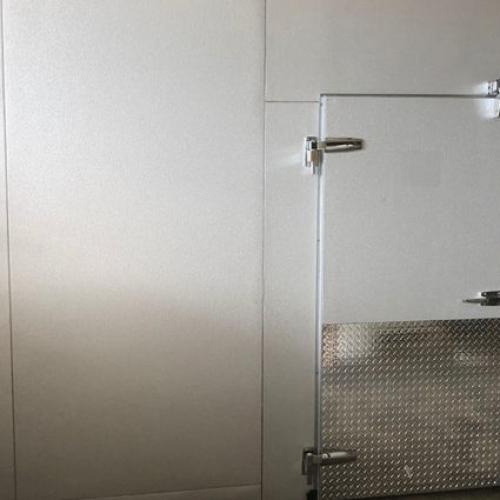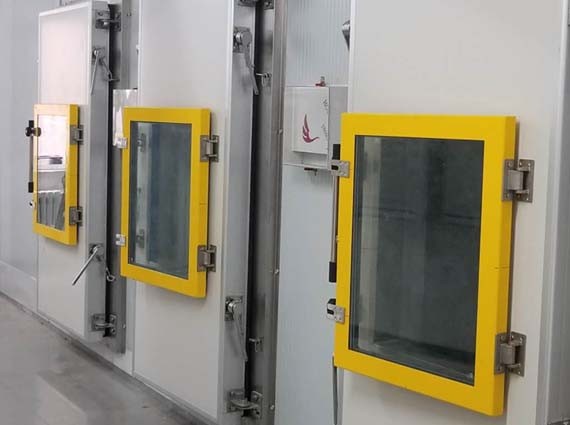
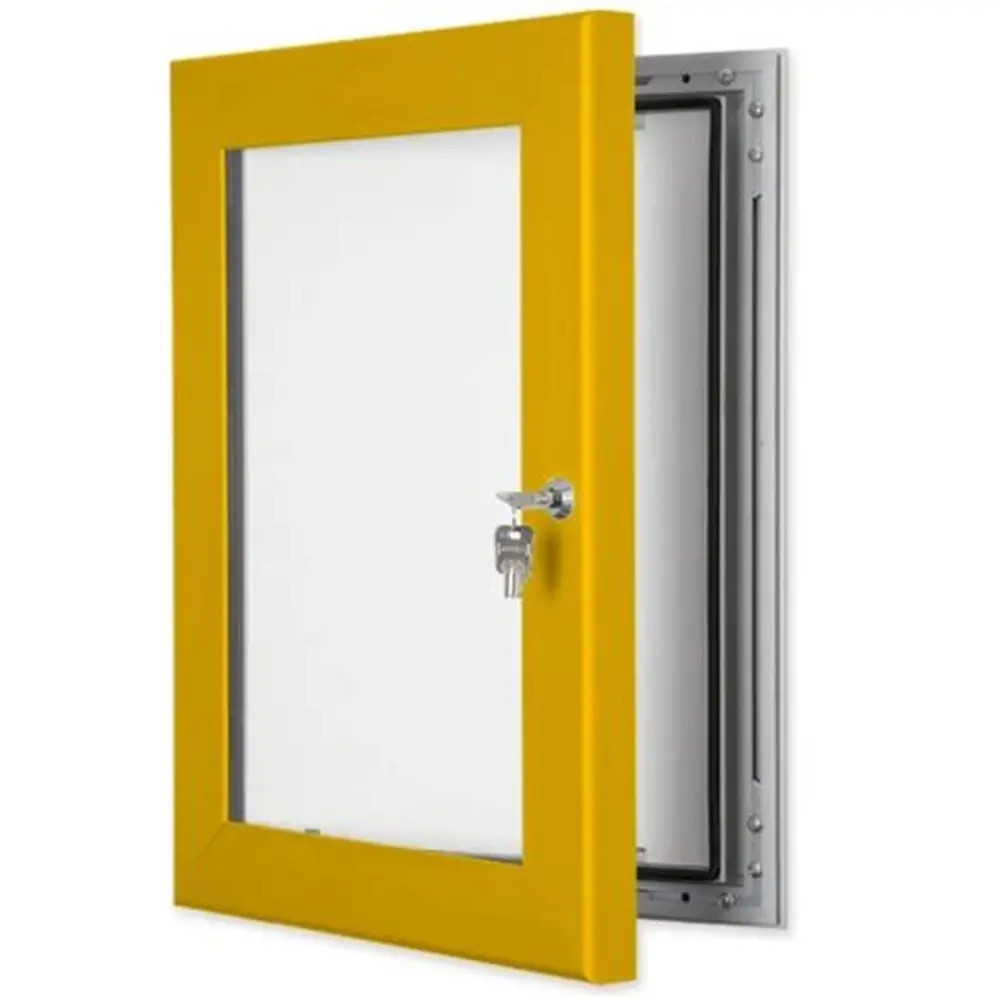
double glazed cold storage window

Our double glazed cold storage window is a high-performance insulated viewing window engineered specifically for low-temperature cold rooms, freezers, and refrigerated warehouses. It features two layers of tempered safety glass, hermetically sealed with a dehydrated air or argon gas-filled spacer, delivering exceptional thermal resistance, anti-condensation, and long-term durability.
Designed to minimize heat ingress and stabilize internal temperatures, this window effectively lowers energy consumption while maintaining clear visibility for operational monitoring. The robust reinforced aluminum frame with multi-layer sealing ensures airtightness, prevents frost buildup, and withstands the harsh, high-humidity environment of cold storage facilities.
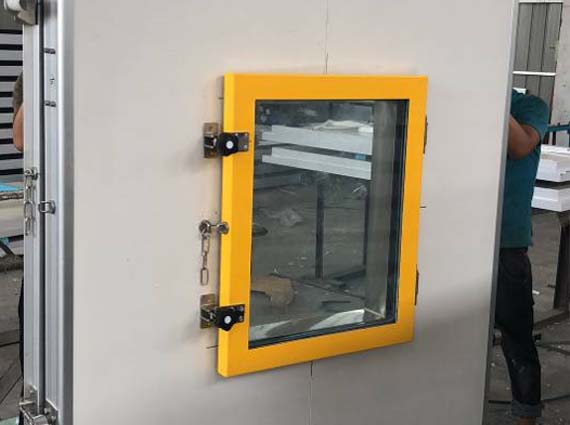
Superior Thermal Insulation Performance
Double glazed cold storage windows are engineered with a core insulated glass unit (IGU) structure, consisting of two high-strength tempered glass panes separated by a precisely sized air or inert gas cavity. This design fundamentally disrupts the rapid heat transfer path of single-pane glass. The sealed cavity is typically filled with argon or krypton gas, which has much lower thermal conductivity than ordinary air, further enhancing the insulation effect. Equipped with a low-emissivity (Low-E) coating on the glass surface, the window can reflect infrared radiation, effectively blocking external heat from entering the cold storage and preventing internal cold air from escaping. It achieves an extremely low U-value (thermal transmittance coefficient), usually below 1.0 W/(m²·K), which is far superior to traditional single-pane windows.

Excellent Anti-Condensation and Moisture-Proof Capability
A key challenge for cold storage windows is condensation caused by large temperature differences between the inside and outside. The double-glazed structure effectively solves this problem. The sealed cavity between the two glass panes is filled with dry gas and equipped with a high-efficiency molecular sieve desiccant, which continuously absorbs moisture in the cavity, keeping the internal space dry for a long time and avoiding fogging or condensation on the inner glass surface. The window adopts a multi-layer sealing system, including high-quality butyl rubber and structural sealant, which forms an airtight and watertight barrier.

High Structural Strength and Durability
The glass used in double glazed cold storage windows is high-quality tempered safety glass, which has 3-5 times the impact resistance of ordinary glass. Even if broken, it will shatter into small, harmless granular fragments, reducing the risk of injury. The window frame is usually made of reinforced aluminum alloy or stainless steel, with high mechanical strength, corrosion resistance, and ability to withstand the pressure changes and temperature fluctuations in cold storage environments. The connection between the glass and the frame adopts a professional thermal break design, which blocks the thermal bridge effect, prevents the frame from becoming a channel for heat transfer, and ensures the overall insulation performance.
Outstanding Visibility and Light Transmission
While ensuring insulation, double glazed cold storage windows maintain excellent light transmission performance. The Low-E coating has high transmittance for visible light, allowing sufficient natural light to enter the cold storage, facilitating internal observation, operation, and safety inspections. The double-layer glass structure does not significantly reduce light transmittance, and the surface is treated to be smooth and easy to clean, effectively resisting dust and dirt adhesion, maintaining long-term clarity. This feature is crucial for cold storage facilities that require real-time monitoring of stored goods, such as food cold storage, pharmaceutical warehouses, and cold chain logistics centers, enabling staff to clearly observe the internal situation without opening the door, reducing cold air loss and improving operational efficiency.

· PrFood processing workshops
· Cold stores and freezer rooms
· Cold chain logistics centres and distribution warehouses
· Pharmaceutical factories and cleanrooms
· Biological laboratories and sample repositories
· Flower preservation chambers
· Low-temperature storage for
| Size | cold storage glass window | Height |
| Small | 600mm (23.6 inches) | 600mm (23.6inches) |
| Medium | 800mm (31.5 inches) | 800mm(31.5inches) |
| Large | 1000mm (39.4 inches) | 1000mm(39.4inches) |
Materials
| Frame | Silver Anodized Aluminum |
| Clamp/Wraparound | Suitable for panel & stud partition walls |
| Vision Panel Options |
4mm Single Glazed Polycarbonate,Clea r6mm Double Glazed /Polycarbonate / Toughened/Laminated Glass, |
| Glass Safety | ClearShatter Proof Films |
| Low Conductivity | Argon Filled double glazed units |
| Thermal Break | Thermally Broken Frames from internal to externa! |
|
Temperature Range |
+81'℃ to -41℃ |
Cold Room Window & Pressure Relief Vent FAQs
I. Cold Room Observation Window (Viewing Panel)
1. What is the primary purpose of a Cold Room Observation Window?
The primary purpose of an Observation Window is to allow personnel outside the cold room to visually inspect the interior without having to open the door. This minimizes unnecessary air exchange, reduces cold loss, and maintains temperature stability, while also serving as a safety feature.
2. Why are these windows typically multi-pane (double or triple glazed)?
They are multi-pane to provide superior thermal insulation (low U-value). The air or inert gas (like Argon) sealed between the panes acts as an insulating barrier, preventing the transfer of heat from the warmer exterior to the colder interior, which is critical for minimizing energy loss and cold bridging.
3. Why do cold room windows require electric heating?
Electric heating is essential in low-temperature applications to prevent condensation (on the warm side) and frost/ice formation (on the cold side). By slightly heating the glass surface above the dew point of the surrounding air, it ensures the glass remains clear and transparent for viewing.
4. What material is commonly used for the window frame?
The frame is typically made from corrosion-resistant materials such as high-strength aluminum alloy, stainless steel, or specialized rigid PVC/plastic. The material must withstand the cold temperatures, be durable, and provide a secure, airtight seal with the cold room panel.
5. How is the Observation Window installed to ensure airtightness?
Airtightness is achieved by using specialized gasket seals and applying a flexible, cold-resistant sealant/caulking around the perimeter where the frame meets the cold room panel. This prevents the infiltration of warm, moist ambient air, which would lead to condensation and ice buildup inside the wall structure.
6. Can standard residential windows be used in a cold room?
No, standard residential windows are unsuitable. They lack the necessary thermal break, multi-pane insulation, and integrated electric heating required to prevent severe cold loss, condensation, and ice formation in continuous low-temperature environments.
7. What is the ‘Thermal Break’ feature in a cold room window?
A Thermal Break is a material barrier (usually a non-metallic, low-conductivity polymer) that separates the inner and outer layers of the window frame. Its function is to interrupt the flow of heat, preventing the frame from becoming a "cold bridge" that conducts heat into the cold room and causes external condensation/frosting.
II. Cold Room Pressure Relief Vent (Pressure Equalizer)
8. What is a Cold Room Pressure Relief Vent (PRV)?
A Pressure Relief Vent, or Pressure Equalizer, is a specialized component installed on the cold room wall to automatically equalize the air pressure between the cold room interior and the ambient exterior.
9. Why is pressure equalization necessary in a cold room?
Pressure differences occur due to:
-
Door Opening/Closing: Rapid door cycling can cause sudden pressure pulses.
-
Rapid Cooling/Pulldown: Cooling air contracts, creating negative pressure (vacuum).
-
Defrost Cycles/Heating: Heating air expands, creating positive pressure.If left unchecked, negative pressure can make doors extremely difficult to open (vacuum effect), and both positive and negative pressures can cause structural damage (bowing/cracking) to the cold room panels.
10. How does a PRV typically operate?
A typical PRV operates passively using a lightweight valve or flap system. When the pressure differential exceeds a small, set threshold (e.g., $10 \text{ Pa}$ or $0.04 \text{ inches}$ water gauge), the valve automatically opens to allow air to flow in or out until the pressure is equalized, then closes again.
11. Do Pressure Relief Vents also require electric heating?
Yes, especially in freezer rooms. Because the PRV is a deliberate opening in the wall, it must be equipped with electric heating to prevent moisture from the exchanged air from condensing and freezing the valve mechanism shut. A frozen PRV cannot function, leading to potential structural failure.
12. Where should the PRV be installed on the cold room wall?
The PRV should be installed at a location where it can be protected from physical damage, typically on an exterior wall. For walk-in freezers, two PRVs are often recommended for large rooms, located high on the wall to ensure efficient pressure regulation throughout the volume.
13. What is the difference between a one-way and a two-way PRV?
-
One-Way Vent: Only allows air to flow in one direction (e.g., designed to only relieve negative pressure). Less common for general cold rooms.
-
Two-Way Vent: The standard type, designed to relieve both positive pressure (outflow) and negative pressure (inflow), which is essential for environments with frequent temperature and volume changes.
14. How do I size or determine the number of PRVs needed for a cold room?
Sizing depends on the cold room volume, the rate of air exchange (door frequency), and the rate of temperature change (defrost/pulldown). Manufacturers provide selection charts based on these parameters. Larger rooms and those with high traffic or rapid temperature drops require more or larger PRVs.
III. Maintenance and Troubleshooting
15. What are the signs that a PRV may be blocked or malfunctioning?
The clearest signs are difficulty in opening the cold room door (due to negative pressure) or structural movement (bowing or bulging of wall panels). In a freezer, visible ice buildup around the vent opening suggests a failure of the heating element or excessive moisture ingress.
16. Why is there heavy condensation on the outside of my observation window?
Heavy external condensation indicates that the electric heating is either off or malfunctioning, or that the thermal break of the window frame is compromised. The cold inner surface of the glass is chilling the exterior surface below the ambient air's dew point.
17. How should a cold room window (glass) be cleaned?
The glass should be cleaned with non-abrasive, ammonia-free cleaning solutions. For heated windows, it is critical to ensure that no water or cleaning solution seeps into the frame or damages the electrical components and seals.
18. How should the electric heating element be tested?
The heating element can be tested by checking for power supply at the connection points and measuring the resistance across the heating element using a multimeter. An open circuit (infinite resistance) or a short circuit (zero resistance) indicates a failure.
19. What can be done to reduce frost buildup on the PRV?
Ensure the heating element is operating correctly and continuously. Also, check the surrounding seals on the wall panel to prevent moist ambient air from entering the wall structure and concentrating moisture near the vent.
20. What is a common mistake when installing a cold room PRV?
A common mistake is failing to connect the electric heating or connecting it to a circuit that is easily turned off. For freezer rooms, the PRV heater must run continuously to prevent freezing and ensure the vent is functional at all times.