

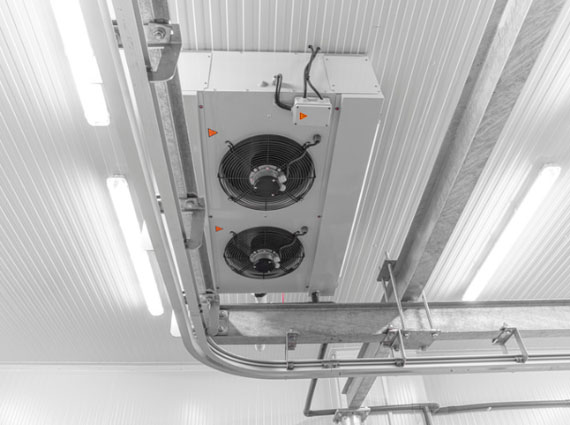
What is a Ceiling Mounted Cold Room Indoor Unit?
It is a terminal heat exchange device suspended beneath the cold storage ceiling, comprising core components such as evaporator coils, fans, air diffusers, drip pans, and defrosting systems (hot gas/electric defrost). Working in conjunction with an outdoor condensing unit, it cools the air within the cold storage via forced convection to fulfil low-temperature storage requirements. Compared to floor-standing units, its key advantages include:
- No floor space occupation- Uniform air distribution
- Adaptability to various cold room dimensions
Suitable for:
- Fresh-keeping rooms above 0°C
- Freezer rooms below -18°C
What are the core types and application scenarios?
|
Type |
Cooling Capacity |
Temperature Range |
Typical Applications |
Core Features |
|
Small-sized (1-5kW) |
1-5kW |
0~10℃ |
Mini cold rooms (supermarket display cabinets, small catering cold storage) |
Compact, low noise, easy installation |
|
Medium-sized (6-20kW) |
6-20kW |
-5~5℃ |
Commercial cold storage (vegetable, meat, seafood storage) |
Stable performance, dual-side air supply |
|
Large-sized (21-60kW) |
21-60kW |
-18~-5℃ |
Industrial cold storage (food processing plants, logistics cold warehouses) |
High-power fans, multiple defrost modes, anti-corrosion coils |
|
Ultra-large (>60kW) |
>60kW |
-30~-18℃ |
Deep-freeze warehouses (IQF freezing, pharmaceutical cold storage) |
Customized coils, frequency conversion fans, intelligent control |
How does it differ from wall-mounted/floor-standing indoor units?
Space utilization: Ceiling-mounted units free up floor/wall space, ideal for small cold rooms or warehouses with dense shelving.
Air distribution: 360° or dual-side air supply ensures uniform temperature, avoiding local hot spots common in wall-mounted units.
Installation difficulty: Requires ceiling load-bearing and height clearance (≥30cm above the unit for maintenance/airflow); wall-mounted/floor-standing units are easier to install but have space constraints.
Cost: Ceiling-mounted units have slightly higher initial costs due to installation complexity, but lower long-term operational costs from better energy efficiency.
Price Comparison Table (2026 Market Reference)
Model Specification
Cooling Capacity
Power (Fan + Defrost)
Price Range (FOB)
Applicable Cold Room Size
Brand Grade
Small (1-2HP)
1-3kW
0.3-0.8kW
$500-$1,200
5-20㎡
Economy (OEM/ODM)
Small (3-5HP)
4-8kW
0.9-1.5kW
$1,200-$2,000
21-50㎡
Economy (OEM/ODM)
Medium (6-10HP)
9-18kW
1.6-2.5kW
$2,000-$3,500
51-100㎡
Mid-range (Branded, e.g., Carrier, Danfoss)
Large (11-15HP)
19-30kW
2.6-3.8kW
$3,500-$5,500
101-200㎡
Mid-range (Branded)
Extra-large (16-20HP)
31-45kW
3.9-5.2kW
$5,500-$8,000
201-300㎡
Premium (Customized, industrial-grade)
Ultra-large (>20HP)
>45kW
>5.2kW
$8,000-$15,000
>300㎡
Premium (Customized, with frequency conversion)
What factors affect the final price?
Cooling capacity: The most critical factor—price increases with capacity (e.g., a 5kW unit costs ~$1,200, while a 20kW unit costs ~$5,000).
Brand and quality: Premium brands (Carrier, Bitzer) cost 30-50% more than OEMs due to better materials (stainless steel coils vs. aluminum) and longer warranties (3-5 years vs. 1 year).
Additional functions: Inverter fans (+$300-$800), hot gas defrost (+$200-$500), anti-corrosion coating (+$150-$300), and intelligent control systems (+$500-$1,000) add to the cost.
Installation and logistics: Installation costs (labor + accessories) account for 20-30% of the unit price; long-distance shipping adds $100-$500 per unit.
Customization: Special sizes (non-standard dimensions), low-temperature adaptation (-30℃), or explosion-proof designs can double the base price.
Is there a cost-effective purchasing strategy?
Match capacity to cold room size: Avoid over-sizing (wastes energy) or under-sizing (insufficient cooling). Calculate based on cold room volume, insulation thickness, and heat load (e.g., a 50㎡ cold room with R20 insulation needs ~6kW capacity).
Choose mid-range brands for commercial use: Balance quality and cost (e.g., Carrier mid-range units offer 2-year warranties at 20% lower prices than premium lines).
Bulk purchasing: For multiple cold rooms, bulk orders can reduce unit prices by 10-15%.
Consider long-term costs: Inverter-equipped units cost 15-20% more initially but save 30-40% on energy bills annually.
How to calculate the required cooling capacity?
Use the formula: Cooling Capacity (kW) = Cold Room Volume (m³) × Heat Load Factor (kW/m³) × Temperature Difference (ΔT).
Heat Load Factor: 0.04-0.06kW/m³ for insulated cold rooms (R15-R25 insulation); 0.07-0.1kW/m³ for frequently opened cold rooms (e.g., supermarket walk-ins).
ΔT: Difference between ambient temperature (e.g., 30℃) and cold room set temperature (e.g., 0℃) = 30℃.
Example: A 100m³ cold room (R20 insulation) with ΔT=30℃ → 100×0.05×30=150kW (choose a 150kW unit or multiple combined units).
Key technical parameters to consider when purchasing
Airflow rate: Measured in m³/h; ensure 8-12 air changes per hour for cold rooms (e.g., a 50m³ cold room needs 400-600m³/h airflow).
Noise level: Below 60dB for commercial applications; below 70dB for industrial use (low-noise models have noise-reducing fans and vibration pads).
Defrost system: Hot gas defrost is energy-efficient for large units; electric defrost is suitable for small units (ensure defrost cycle is 4-6 times/day, 15-20 minutes each).
Refrigerant compatibility: R404A, R407C, R507 are common; new models support low-GWP refrigerants (R290, R600a) for environmental compliance.
IP rating: IP54 for food processing plants (dust/water resistance); IP65 for outdoor-installed ceiling units.
Can it be customized for special needs?
Yes. Common customizations include:
Coil material: Stainless steel coils for corrosive environments (e.g., seafood cold storage) instead of aluminum.
Fan type: Frequency conversion fans for variable speed control (saves 25-35% energy).
Air supply direction: Single-side, dual-side, or bottom air supply based on cold room layout.
Control system: Integration with BMS (Building Management System) for remote monitoring and automatic defrost scheduling.
Customization typically adds 10-30% to the base price and extends lead time by 2-4 weeks.
How to improve energy efficiency?
Choose inverter models: Adjust fan speed based on temperature, reducing energy consumption by 30-40%.
Optimize defrost cycles: Avoid frequent defrosting (4-6 times/day is optimal); use hot gas defrost instead of electric defrost.
Seal cold room gaps: Ensure door seals are intact and install air curtains to reduce cold air loss.
Regular maintenance: Clean filters/coils monthly to maintain heat exchange efficiency.
What is the typical service life and warranty period?
Service life: 8-15 years for mid-range/premium units (depends on maintenance and usage frequency); 5-8 years for economy models.
Warranty: 1-3 years for OEM units; 3-5 years for branded units (covers parts like fan motors, coils, and control boards). Extended warranties (5-10 years) are available for an additional 10-15% of the unit price.
Are there energy-saving certifications to look for?Look for CE, ISO 9001, and ENERGY STAR certifications. EU-based units may have ERP labels (energy efficiency class A++ to A+++). These certifications ensure the unit meets international energy standards, reducing long-term operational costs.
Post time:Sep-25-2020
