

How to Converting Your Cold Storage Sliding Doors From Manual to Automated
In the fast-paced world of industrial warehousing and food logistics, efficiency is the currency of success. Yet, one of the most overlooked bottlenecks in many facilities is the humble manual sliding door of the walk-in freezer or cold storage unit.
While manual doors are reliable and simple, they are often the primary source of operational friction. If you find yourself constantly reminding staff to close the door, or if your electricity bills are skyrocketing due to "temperature creep," it’s time to talk about automation. Converting a manual cold storage door to an electric one isn't just a luxury—it’s a strategic upgrade.
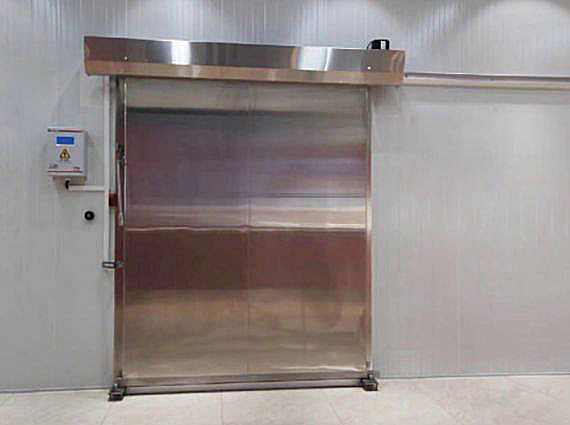
Part I: Why Make the Switch? (The Business Case)
Before we dive into the grease and gears, let’s look at the "Why." An automation project requires an investment of time and capital, so the benefits must be clear.
1. Superior Thermal Efficiency
Every second a cold storage door remains open, your refrigeration system has to work exponentially harder to combat the influx of warm, humid air. Manual doors are notorious for being left "half-cracked" or taking too long to slide shut. Electric doors, equipped with auto-close timers, ensure the opening duration is minimized to the absolute necessity.
2. Improved Food Safety and Compliance
In industries governed by HACCP or FSMA, maintaining a consistent cold chain is non-negotiable. Fluctuations in temperature can lead to bacterial growth or spoiled inventory. Automation provides a predictable, repeatable seal that manual operation simply cannot guarantee.
3. Workplace Safety and Ergonomics
Cold storage doors are heavy. They are designed with high-density insulation and thick gaskets to maintain thermal integrity. Repeatedly pulling a 200lb door can lead to repetitive strain injuries for employees. Furthermore, an electric door with safety sensors prevents accidents where a door might be slammed on a worker or a forklift.
4. Reduced Wear and Tear
It sounds counterintuitive, but manual doors often break faster. Why? Because humans are inconsistent. People kick doors open, slam them shut, or yank on handles at odd angles. An electric drive system applies constant, calculated force, which actually extends the life of the door’s rollers and tracks.
Part II: Assessing Your Existing Infrastructure
You can’t just slap a motor on any door and hope for the best. Before purchasing a conversion kit, conduct a thorough audit.
The "Roll" Test
If your door doesn't slide smoothly manually, it won't work electrically. Check for:
-
Track Alignment: Is the track level? Any dips will cause the motor to burn out.
-
Roller Condition: Are the bearings seized? Replace them before automating.
-
Gasket Friction: Ensure the bottom and side gaskets aren't creating excessive "drag" that exceeds the motor’s torque rating.
Clearances and Space
Electric motors require a "drive-end" space. You’ll need to ensure there is enough room on the wall (usually 12–18 inches beyond the track) to mount the motor and drive sprocket.
Part III: The Technical Architecture of an Electric Conversion
A typical conversion kit consists of several core components. Understanding these is vital for the installation phase.
-
The Gear Motor: Usually a high-torque, low-RPM AC or DC motor. For cold environments, these must be rated for low temperatures to prevent lubricant freezing.
-
The Drive Train: Typically a #40 or #50 roller chain or a reinforced timing belt. Chains are more durable for heavy industrial doors, while belts are quieter.
-
Variable Frequency Drive (VFD): This is the "brain." It allows for "soft start" and "soft stop" functionality. This prevents the door from jerking, which protects the mechanical components.
-
The Controller: This manages inputs from sensors, pull-cords, and remote controls.
Part IV: Step-by-Step Conversion Guide
Step 1: Prep and Safety First
Lock out the area. Ensure the refrigeration system isn't going to be compromised during the hours the door might be immobile.
Note: If the door is the only exit, ensure an emergency release is installed first.
Step 2: Mounting the Drive Track
Most conversion kits come with a secondary rail or an extension to the existing track. Mount the motor bracket securely to the wall. Since cold room walls are often sandwich panels (foam between metal), you must use through-bolts with backer plates on the other side of the wall. Screwing into the sheet metal alone will fail.
Step 3: Installing the Drive Mechanism
Attach the drive chain or belt to the door carriage.
-
Leading Edge Attachment: The motor pulls the door from the front during opening.
-
Tensioning: Ensure the chain has about 1/2 inch of play. Too tight, and you'll snap the motor shaft; too loose, and it will jump the sprocket.
Step 4: Electrical Wiring
This is where you may need a certified electrician. You will need:
-
Power Supply: Typically 220V single-phase or 480V three-phase depending on the motor.
-
Control Wiring: Low-voltage wires running to the pull-cords or motion sensors.
-
Heater Cables: If you are in a freezer (below 0°C), you must ensure the motor and the track have heat traces to prevent ice buildup.
Step 5: Programming the Limits
Using the VFD or Controller, you must set the Limit Switches.
-
Open Limit: Tell the motor where to stop so it doesn't fly off the track.
-
Closed Limit: Tell the motor where to stop so it seals firmly against the gaskets without crushing them.
Part V: Essential Safety Features
You cannot skip these. An automated door is a powerful machine that can cause serious injury if not regulated.
| Feature | Function |
| Photo-eye Sensors | Prevents the door from closing if a person or forklift is in the threshold. |
| Leading Edge Reversing Strip | A pressure-sensitive strip on the door edge that triggers an immediate reverse if it hits an object. |
| Manual Release | A clutch or lever that allows the door to be moved by hand during a power failure. |
| Warning Lights/Alarms | A strobe or beeper that activates 2 seconds before the door moves. |
Part VI: Maintenance Protocol for Automated Doors
Once your door is electric, your maintenance routine changes. It’s no longer just about grease; it's about calibration.
-
Monthly: Check the tension of the drive chain. Wipe down the photo-eyes to remove frost or dust.
-
Quarterly: Inspect the electrical connections for corrosion caused by condensation.
-
Annually: Perform a "Load Test." Does the door reverse properly when it hits an obstruction? If not, recalibrate the torque settings on the VFD.
Conclusion: A Future-Proof Facility
The transition from a manual cold storage door to an electric one is more than just a mechanical upgrade; it's an investment in your facility's longevity and your team's productivity. By reducing energy waste, improving safety, and ensuring a consistent seal, you are protecting your bottom line.
While the DIY route is possible for those with strong mechanical and electrical backgrounds, always consult with your door manufacturer to ensure the conversion kit is compatible with your specific door model.
Post time:Sep-25-2020
