

Stop the Chill Loss: Why Your Facility Needs an Energy Saving Air Curtain
Introduction: The Invisible Thief in Your Warehouse
In the cold storage and logistics industry, there is an invisible thief that works around the clock. It doesn’t steal physical inventory, and it doesn’t break locks. Instead, it steals something arguably just as valuable: thermal energy.
Every time a forklift drives through a freezer door, or a chef walks into a walk-in cooler, a massive invisible exchange occurs. Heavy, expensive cold air tumbles out along the floor, while warm, humid, contaminant-laden air rushes in through the top of the opening. This phenomenon, known as air infiltration, is the single biggest contributor to energy waste in refrigeration.
For decades, the industry relied on PVC strip curtains to mitigate this loss. While better than nothing, strip curtains are prone to scratching, clouding, trapping bacteria, and eventually breaking off—not to mention the safety hazard they pose by obscuring visibility.
Enter the Energy Saving Air Curtain.
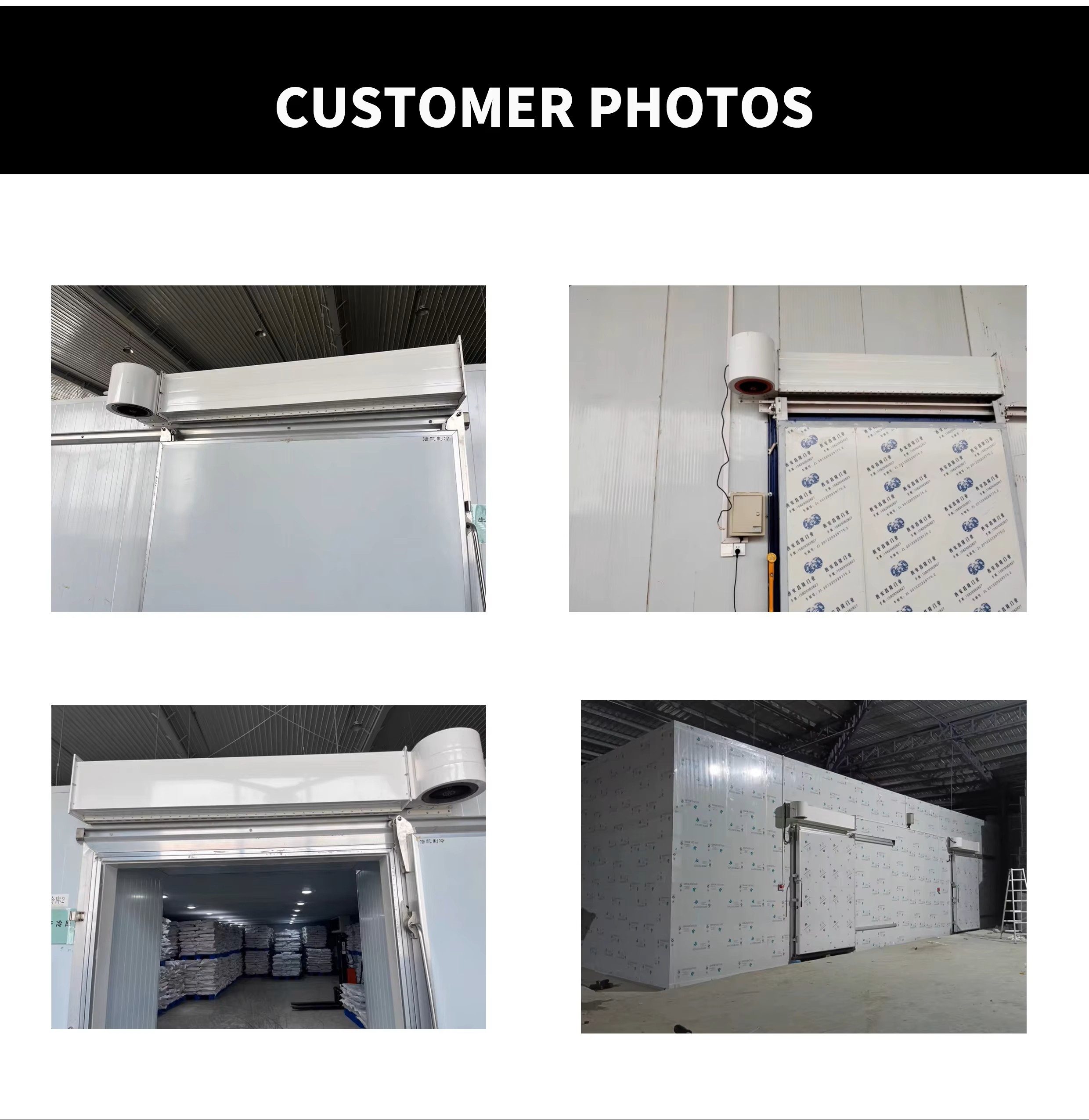
Once reserved for high-end retail entrances, air curtain technology has evolved into a robust, industrial-grade solution specifically engineered for the harsh environments of blast freezers, cold rooms, and refrigerated warehouses.
In this comprehensive guide, we will explore why an energy-saving air curtain is no longer a luxury add-on but a critical infrastructure investment. We will break down the physics of thermal loss, the calculation of Return on Investment (ROI), the impact on machinery lifespan, and the critical role air curtains play in hygiene and safety compliance.
Chapter 1: The Physics of the Problem (Why You Are Losing Money)
To understand the solution, we must first understand the problem at a granular level. Why exactly is an open door so expensive?
1.1 The Stack Effect and Air Density
Cold air is significantly denser than warm air. When a cold storage door opens, the laws of thermodynamics trigger an immediate equalization process.
-
The Outflow: The heavy cold air inside your freezer acts like water behind a dam. As soon as the door opens, it "spills" out across the floor.
-
The Inflow: To replace that displaced volume, warm, lighter air from the outside (or the loading dock) rushes in through the top of the doorway.
This creates a rotating cycle of air movement called the Stack Effect. The greater the temperature difference (Delta T) between the inside and outside, the faster and more violent this exchange is. For a blast freezer operating at -30°C (-22°F) opening into a +25°C (77°F) loading dock, the air exchange happens in seconds.
1.2 The Moisture Enemy
It isn't just heat entering your freezer; it is moisture. Warm air holds significantly more water vapor than cold air. When that humid air enters your sub-zero environment, it instantly condenses and freezes. This leads to:
-
Snow/Frost accumulation on products and shelving (obscuring labels).
-
Ice buildup on the evaporator coils (forcing more defrost cycles).
-
Slippery ice patches on the floor (a major safety hazard).
1.3 The Limitations of Physical Barriers (PVC Strips)
For years, PVC strip curtains were the standard solution. However, they suffer from diminishing returns:
-
Wear and Tear: Forklifts eventually rip them down.
-
Hygiene: They collect grease, dirt, and bacteria, requiring frequent cleaning.
-
Efficiency Drop: As strips warp or gaps appear, their sealing ability drops to near zero.
-
Workflow: Drivers must slow down to push through them, reducing operational efficiency.
Chapter 2: How an Industrial Air Curtain Works
An air curtain (also known as an air door) is a fan-powered device created to separate two different environments while allowing a smooth, uninterrupted flow of traffic.
2.1 The Aerodynamic Seal
Unlike a residential fan, a cold storage air curtain uses a specialized blower wheel and a plenum chamber to compress air. This air is forced through a discharge nozzle containing adjustable vanes (airfoils).
The result is a laminar air stream—a uniform sheet of air that travels at a high velocity across the entire width of the opening. This stream hits the floor with enough force to create a "split."
-
80% of the air returns to the intake side (recirculating).
-
20% of the air splits outward.
This split creates a virtual wall that prevents the heavy cold air from spilling out and the light warm air from penetrating in.
2.2 Cold Storage vs. Standard Models
It is crucial to distinguish between a "Comfort Air Curtain" (used in coffee shops) and a "Cold Storage Air Curtain."
-
Velocity: Cold storage units require much higher air velocity (often 15m/s to 25m/s) to cut through the dense mass of cold air.
-
IP Rating: Freezer units must be waterproof (IP54 or higher) to withstand condensation and wash-downs.
-
Motor Durability: They use specialized bearings and lubricants designed to operate in sub-zero temperatures without seizing.
Chapter 3: The Economic Argument (ROI and Energy Savings)
The primary driver for installing air curtains is financial. Let’s break down where the savings come from.
3.1 Reducing the Compressor Load
Your refrigeration system’s primary job is to remove heat. Every cubic foot of warm air that enters the room adds "heat load" that the compressor must remove.
-
The Calculation: Studies by HVAC associations (like AMCA) indicate that a properly installed air curtain can retain 80% to 90% of conditioned air.
-
The Result: If your compressor runs 18 hours a day to maintain temperature with an open door, an air curtain could reduce that run time to 12-14 hours.
-
The Savings: This direct reduction in kilowatt-hours (kWh) creates immediate cash flow. For a medium-sized cold storage facility, this can equate to thousands of dollars in savings annually.
3.2 Extending Equipment Lifespan
Refrigeration compressors are most stressed during "start-up." Short-cycling—turning on and off frequently to handle temperature spikes caused by door openings—is the leading cause of compressor failure.
By maintaining a stable internal temperature, the air curtain allows the compressor to run in longer, more efficient cycles and turn off for longer periods. This significantly extends the life of your HVAC hardware, delaying expensive capital replacement costs.
3.3 Reducing Defrost Cycles
As mentioned, air curtains block moisture. Less moisture means less frost on the evaporator coils.
-
Standard Operation: A freezer might run a defrost cycle (using electric heaters or hot gas) 4 times a day.
-
With Air Curtains: You may be able to reduce this to 2 or 3 times a day.
Since the defrost cycle consumes energy (to heat the coils) and pauses the cooling process, reducing its frequency is a "double win" for efficiency.
Chapter 4: Safety, Hygiene, and Compliance
Beyond money, air curtains solve critical operational headaches related to safety and food standards.
4.1 Eliminating the "Fog Zone"
When a forklift exits a -20°C freezer into a +30°C loading dock, the collision of air temperatures often creates an instant, dense fog. This blinds the driver for several seconds—a recipe for disaster in a busy warehouse.
An air curtain prevents this thermal shock at the doorway, keeping the air clear and visibility high.
4.2 Preventing Ice Accidents
Slip-and-fall accidents are a leading cause of Workers' Compensation claims in the cold chain industry. Ice usually forms exactly where people walk—right at the threshold of the freezer door.
By sealing the opening, air curtains keep the floor dry and ice-free. This not only protects employees but also protects forklifts from losing traction and crashing into door frames or racking.
4.3 Pest Control (The Invisible Screen)
For food processing plants, pests are a nightmare. Flies, gnats, and bees are attracted to food smells.
-
The Barrier: An air stream traveling at speeds over 3-5 meters per second is impenetrable to flying insects. They simply cannot generate enough lift to fly through the turbulence.
-
Hygiene Compliance: Using air curtains allows facilities to meet strict HACCP, FDA, and BRC global standards for pest control without using chemical sprays near food products.
4.4 Odor and Dust Control
If your facility stores fish in one room and dairy in another, cross-contamination of odors is a risk. Air curtains isolate odors effectively. Additionally, they prevent dust, exhaust fumes from trucks, and airborne pollutants from entering the "Clean Zone" of your facility.
Chapter 5: Selecting the Right Air Curtain for Your Facility
Not all air curtains are created equal. Installing the wrong size or power level will render the investment useless. Here is a guide to specification.
5.1 Measuring the Door
-
Width: The air curtain must be at least as wide as the door. If the door is 2 meters wide, do not use a 1.8-meter curtain. The gaps at the edges will allow leakage (tunneling effect). It is better to have the curtain slightly wider than the door.
-
Height: This is the most critical factor. The "Effective Throw Distance" of the fan must reach the floor.
-
Small Walk-ins: Door height 2.5m -> Needs ~10-15m/s velocity.
-
Warehouse Doors: Door height 4-5m -> Needs ~20-25m/s velocity.
-
If the air doesn't hit the floor, the seal is broken, and cold air will leak out underneath.
-
5.2 Material Selection
-
Stainless Steel (304 Grade): Mandatory for food processing, meat packing, and areas with high humidity or frequent chemical wash-downs.
-
Powder Coated Steel: Suitable for general warehousing and loading docks where direct food contact is not an issue.
-
Plastic/ABS: Generally only suitable for small commercial coolers (florists, convenience stores), not industrial use.
5.3 Control Systems (The Secret to Efficiency)
An industrial air curtain should not run 24/7. It should only run when the door is open.
-
Plunger/Roller Microswitch: A mechanical switch that physically detects the door opening.
-
Magnetic Reed Switch: A contactless sensor (better for durability).
-
Variable Frequency Drives (VFD): For advanced facilities, VFDs allow you to ramp up the fan speed based on how wide the door is open, or run at a lower speed when the door is closed to provide air circulation (destratification).
Chapter 6: Installation Best Practices
Even the best machine will fail if installed incorrectly.
6.1 Mounting Location
The unit should be mounted on the warm side of the opening whenever possible (e.g., on the loading dock side of a freezer door).
-
Why? If mounted inside the freezer, the air circulating through the fans is sub-zero. This can cause the grease in the bearings to thicken and limits the "defrosting" capability of the air stream. However, if space is limited, specialized "freezer-rated" motors must be used for internal mounting.
6.2 The "Rule of Tilt"
A common mistake is pointing the air stream straight down.
For maximum efficiency, the nozzle vanes should be adjusted to point 10 to 15 degrees outward (toward the warm side/outside). This helps to "push" the incoming warm air back out before it can breach the threshold.
6.3 Maintenance Checklist
While low maintenance, air curtains are not "no maintenance."
-
Monthly: Check the air intake grille. If it is clogged with dust or plastic wrap debris, the motor will overheat and performance will drop.
-
Quarterly: Check the tightness of mounting bolts (vibration can loosen them).
-
Yearly: Inspect the blower wheels for dust buildup. Unbalanced wheels cause noise and bearing failure.
Chapter 7: Comparison – Air Curtains vs. Other Solutions
Feature
Air Curtains
PVC Strip Curtains
High-Speed Roll-Up Doors
Energy Efficiency
High (80-90% retention)
Medium (dropping to Low over time)
Very High (when closed)
Visibility
100% Clear
Poor (Scratches/Cloudy)
N/A (Solid barrier)
Traffic Flow
Unobstructed
Slows traffic down
Wait time for open/close
Maintenance
Low (Cleaning filters)
High (Replacing strips)
High (Mechanical repairs)
Hygiene
Excellent (No touch)
Poor (Collects bacteria)
Good
Upfront Cost
Medium
Low
High
The Winning Strategy: The best setup for a high-traffic industrial freezer is often a combination of a High-Speed Roll-Up Door (for when the warehouse is closed or low traffic) and an Air Curtain (active whenever the door is in use).
Chapter 8: Frequently Asked Questions (FAQ)
Q: Will an air curtain make my cold room too warm?
A: No. While the air curtain uses ambient air (or slightly heated air to prevent mist), the volume of air entering the cold room is negligible compared to the cold air it saves from escaping. The net result is a colder, more stable room.
Q: Are they loud?
A: Industrial units move a lot of air, so there is wind noise. However, modern designs utilize aerodynamic plenum chambers to keep noise levels between 55-75dB, which is generally quieter than a running forklift or a large compressor.
Q: Can I install it vertically?
A: Yes. For very wide or extremely tall doors, vertical air curtains mounted on the sides (blowing horizontally across the opening) are often more effective.
Q: What is the payback period?
A: Depending on energy costs in your region and the frequency of door cycles, most industrial air curtains pay for themselves in energy savings within 6 to 18 months.
Conclusion: An Investment, Not an Expense
In the competitive world of cold chain logistics and food storage, margins are tight. Every kilowatt of electricity wasted cuts directly into your bottom line.
Continuing to rely on open doors or dirty, broken plastic strips is a strategy for the past. The Energy Saving Air Curtain represents a modernization of your facility that delivers immediate benefits:
-
Lower Bills: Up to 30% reduction in energy costs.
-
Better Safety: No ice, no fog, no accidents.
-
Superior Quality: Constant temperatures mean fresher product and less spoilage.
Don't let your profits fly out the door. Seal your facility with the power of air.
Ready to Upgrade Your Cold Storage?
We specialize in high-performance air curtains designed specifically for walk-ins, blast freezers, and refrigerated warehouses.
Post time:Sep-25-2020
