

Why is there ice buildup on my cold room door
In the world of cold chain logistics, food service, and pharmaceutical storage, the cold storage room (or walk-in freezer) is the heart of the operation. It is a massive, energy-consuming beast designed to do one thing: preserve value.
However, there is a silent enemy that plagues thousands of facilities worldwide: Ice Buildup around the Cold Storage Door.
It starts innocently enough—a little frost on the door handle or a thin layer of rime on the strip curtains. But ignored, it grows into a formidable hazard. We aren't just talking about aesthetic issues here. Ice buildup on cold storage doors is a multi-faceted liability:
-
Safety Hazard: Ice dripping onto the floor creates a slip-and-fall zone, one of the leading causes of Workers' Compensation claims in warehouse environments.
-
Energy Hemorrhage: Ice prevents the door from sealing. A gap as thin as a paperclip can cost thousands of dollars in wasted electricity annually as the compressor runs non-stop to combat the infiltration.
-
Equipment Failure: The strain of fighting moisture ingress can burn out evaporator fans, freeze up coils, and destroy door hinges and latches.
-
Regulatory Nightmares: For food and pharma industries, ice accumulation is a violation of FDA, USDA, or GMP standards, signaling a lack of control over the storage environment.
Why does this happen? Is it a bad gasket? A lazy employee propping the door? Or a flaw in the building’s design?
In this definitive guide, we will move beyond simple "tips and tricks." We will explore the thermodynamics of cold storage, dissect the mechanical components of industrial doors, and provide a master-level troubleshooting protocol to banish the ice for good.
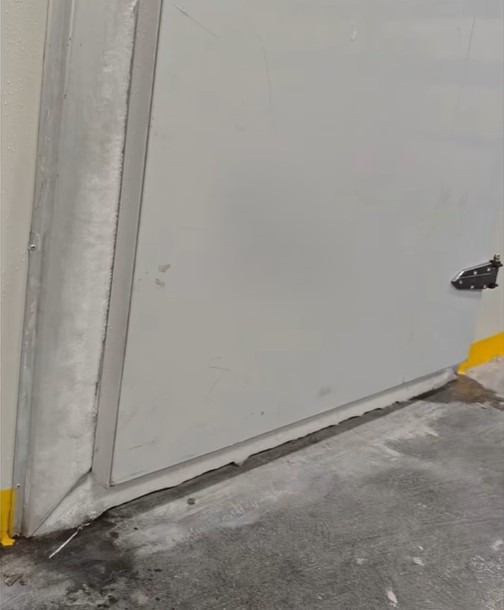
Part I: The Science of Infiltration (Why Ice Happens)
To defeat the ice, you must understand the physics creating it. Ice on a cold storage door is rarely a problem with the freezer itself; it is almost always a problem with the air boundary.
1.1 Psychrometrics 101: The Dew Point
Air holds moisture in the form of water vapor. Warm air can hold a lot of water; cold air can hold very little.
When warm, humid air from your loading dock or kitchen (say, 75°F / 50% RH) comes into contact with the surfaces of your cold storage door (which might be -10°F), the air cools instantly. It loses its capacity to hold water.
-
Condensation: First, the moisture turns to liquid water.
-
Freezing: Because the surface is below 32°F, that water instantly crystallizes into ice.
1.2 The "Stack Effect" (Chimney Effect)
This is crucial for large walk-ins and warehouses. Cold air is denser and heavier than warm air. Inside your cold room, the heavy air pushes outward at the bottom of the door, trying to escape.
Conversely, this creates a vacuum effect at the top of the door, sucking warm, moist air into the freezer.
-
The Cycle: Cold air leaks out the bottom $\rightarrow$ Negative pressure pulls warm air in the top $\rightarrow$ Ice forms at the top of the door frame.
If you see heavy ice specifically at the top header of your door, you are a victim of the Stack Effect.
1.3 Vapor Pressure Differential
Even if the door is closed, nature seeks equilibrium. The high vapor pressure outside the freezer wants to migrate to the low vapor pressure inside. Moisture will relentlessly try to push through microscopic gaps in your seals, keyholes, or even through the panels themselves if the vapor barrier is compromised.
Part II: The Mechanical Suspects (Hardware Failure)
In a commercial setting, hardware takes a beating. Forklifts bump frames; employees slam latches. Here are the mechanical failures that lead to icing.
2.1 The Door Gasket: The First Line of Defense
The gasket is the rubber seal that marries the door to the frame. In commercial units, these are often magnetic or compression-style.
-
Compression Set: Over time, rubber loses its memory. It stays flat instead of bouncing back. If the gasket is flat, it cannot form a seal against the jamb.
-
The "Sweep" Failure: On walk-in doors, the bottom seal consists of a rubber "sweep" that drags along the floor. If the floor is uneven, or if the sweep is worn, the heavy cold air pours out (see "Stack Effect"), creating an ice slick on the threshold.
2.2 The Door Heater Cable (The Silent Failure)
Unlike a home fridge, commercial freezer doors have a perimeter heater wire embedded in the door frame (and sometimes the door edge).
-
Function: This wire keeps the metal facing of the door frame warm (usually just above the dew point).
-
The Symptom: If this heater fails, the metal frame becomes freezing cold. Condensation forms immediately on the metal frame, freezes, and welds the gasket to the metal. When you force the door open, you rip the gasket.
-
Diagnosis: Touch the door frame. It should feel slightly warm to the touch. If it is icy cold, your anti-sweat heater circuit is dead.
2.3 Misaligned Hinges and Latches
Commercial doors are heavy. Over years of use, gravity takes its toll.
-
Cam-Lift Hinges: Most walk-ins use cam-lift hinges that physically lift the door as it opens and let it drop into a tight seal when it closes. If the cam (the plastic or metal ramp inside the hinge) is worn down, the door won't "drop" into the seal. It just rests against the frame, leaving a gap.
-
Sagging: If the door sags, the top corner opposite the hinge pulls away from the frame. You will see ice buildup specifically in that top corner.
2.4 The Pressure Relief Port (The Vent)
When you close a freezer door, you are trapping air. As that air cools, it shrinks, creating a vacuum. Without a vent, the suction would make it impossible to open the door again.
-
The Failure: These vents have little heaters to keep them from freezing shut. If the heater fails, the vent freezes.
-
The Result: The next time you close the door, the air pressure has nowhere to go. It forces its way out through the weakest part of the gasket, blowing a hole in the seal and allowing moisture back in.
Part III: Operational & Environmental Causes
Sometimes the hardware is fine, but the environment or usage is the problem.
3.1 The "Door Propping" Epidemic
In busy kitchens or warehouses, staff often prop the door open during loading/unloading to "save time."
-
The Consequence: Propping a freezer door open for 10 minutes can introduce enough moisture to require a 24-hour defrost cycle to remove. That moisture settles on the nearest cold surface: the door and the ceiling, creating "stalactites."
3.2 Inadequate Air Curtains / Strip Curtains
-
Strip Curtains (PVC): These are the hanging plastic strips. If they are missing, cut, or tied back (a common employee habit), they are useless. They are meant to reduce air infiltration by 50-70% when the main door is open.
-
Air Curtains (Air Doors): These blow a stream of air down across the opening.
-
Common Error: The velocity is set too high or the angle is wrong, actually mixing the warm and cold air rather than separating them. Or, the limit switch is broken, so the fan doesn't turn on when the door opens.
-
3.3 The "Anteroom" Condition
What is the room outside your cold storage?
If your freezer opens directly into a hot, humid loading dock or a steamy commercial kitchen, you are fighting a losing battle. The humidity load is simply too high for the door mechanism to handle.
Part IV: The Comprehensive Troubleshooting Protocol
If you are a facility manager, print this section out. This is your checklist for diagnosing the root cause.
Step 1: The Visual & Tactile Inspection
-
The Flashlight Test:
-
Turn off the lights inside the cold room (if safe) and have someone stand inside.
-
Shine a bright flashlight around the perimeter of the door from the outside.
-
If the person inside sees light, you have a seal breach.
-
-
The Dollar Bill Test (Commercial Edition):
-
Use a dollar bill or a piece of paper. Close the door on it.
-
Test every 12 inches around the frame.
-
If it slides out without resistance, the gasket is not making contact.
-
-
The Heater Check:
-
Place your hand on the door jamb (frame). Is it warm?
-
Pro Tip: Use an infrared thermometer. The frame should be 5-10°F warmer than the surrounding air. If it reads 32°F or lower, check the breaker or the heating element wiring.
-
Step 2: Hinge and Closer Analysis
-
The "Self-Close" Test: Open the door 45 degrees and let go. Does it swing shut and latch completely on its own?
-
If it stops halfway: The hinges are binding or the door is out of level.
-
If it bounces back open: The gasket is too stiff, or the air pressure vent is blocked.
-
-
Check for Sag: Look at the gap between the door and the header. Is it uniform? If the gap is wider on the handle side than the hinge side, the door is sagging.
Step 3: Assessing Air Management
-
Strip Curtain Audit:
-
Are strips missing?
-
Do they overlap by at least 1 inch?
-
Are they touching the floor? (They should just barely touch or hover 1/2 inch above).
-
-
Pressure Relief Port:
-
Locate the vent. Is it covered in ice? Can you hear it "hiss" when the door closes? If it's silent and icy, it's blocked.
-
Part V: The Solutions (Remediation Strategy)
Once you have identified the source, use these solutions.
Solution A: Gasket and Hardware Rehabilitation
-
Replace, Don't Patch: If a gasket is torn, duct tape is not a solution. It creates ridges that allow air leaks. Replace the entire gasket. Ensure you order the correct profile (snap-in vs. screw-in).
-
Adjust Cam-Lift Hinges: Most commercial hinges have a set screw or a mounting plate that allows for adjustment. You may need to loosen the screws and shim the hinge to lift the door back to level.
-
Lubrication: Use a food-grade silicone lubricant on the hinges and the latch mechanism. Never use WD-40, which can gum up in low temperatures.
Solution B: Fixing the Frame Heater
If the frame is cold and icy:
-
Check the Breaker: Often, the heater is on a separate circuit. Has it tripped?
-
Amp Draw Test: A technician should use an amp clamp to see if the heater is drawing current.
-
Retrofit: If the internal wire is burned out and cannot be accessed without ripping out the frame, you can install a surface-mounted heater tape. This is a special heat tape covered by a metal trim strip that screws onto the existing frame.
Solution C: Managing the Air Boundary
-
Install/Upgrade Air Curtains: For high-traffic doors (forklift entry), strip curtains are often insufficient because they get ripped off. Install a high-velocity air curtain.
-
Crucial Setting: The air stream should be angled slightly outward (toward the warm side) to blow dust and heat away from the opening.
-
-
Dehumidification in the Anteroom: If your freezer opens into a humid corridor, attack the humidity at the source. Install a commercial desiccant dehumidifier in the staging area (anteroom) to lower the dew point before the air reaches the freezer door.
Solution D: The "Vestibule" Approach
If you have severe ice issues and the freezer opens directly to the outdoors or a hot kitchen, you may need to construct a vestibule.
-
Concept: Build a small room around the freezer door using simple framing and plastic sheeting or insulated panels.
-
Benefit: This creates an "airlock." When you open the freezer, you are exchanging air with the cool, dry vestibule, not the hot, wet kitchen.
Part VI: Advanced Prevention & Maintenance Technologies
For large-scale operations, manual checks aren't enough. It’s time to modernize.
6.1 IoT Monitoring Systems
Install wireless sensors on the door.
-
Door Open Sensors: Alert the manager via SMS if the door is left open for more than 5 minutes.
-
Frame Temperature Sensors: Monitor the temperature of the door frame. If it drops, the system alerts you that the heater cable has failed before ice starts to form.
6.2 Heated Thresholds
For walk-ins with concrete floors, the floor under the door can freeze, heaving the concrete and breaking the door seal.
-
Solution: Install a hydronic or electric heating loop in the concrete threshold. This ensures the sweep seal never freezes to the floor.
6.3 Fast-Acting Doors (High-Speed Roll-ups)
If your facility uses standard hinged doors for forklift traffic, you are doing it wrong. Hinged doors are slow.
-
The Upgrade: Install High-Speed Roll-Up doors. These open and close in seconds, drastically reducing the window of opportunity for air infiltration. They often come with "break-away" bottom bars that reset automatically if a forklift hits them.
Part VII: Safety and Regulatory Compliance
Ignoring ice is not just a maintenance issue; it is a legal one.
-
OSHA (Occupational Safety and Health Administration): Under the "General Duty Clause," employers must provide a workplace free from recognized hazards. A slippery, icy floor in a freezer entry is a textbook citation waiting to happen.
-
FDA / USDA: In food storage, ice is considered a contaminant. Condensate that drips from a door header onto a pallet of food can contain Listeria or other pathogens. "Condensate drippage" is an immediate critical violation during a health inspection.
-
Structural Integrity: Massive ice buildup adds weight. We have seen cases where the weight of ice on a door assembly caused the hinges to rip out of the foam panels, causing the heavy door to fall.
Conclusion: Melting the Problem Away
Ice on your cold storage door is a symptom of a battle between thermodynamics and mechanics. Thermodynamics is trying to equalize the temperature; your mechanics are trying to stop it. When the mechanics fail, the ice wins.
But the ice does not have to win. By following a systematic approach—verifying the gasket integrity, ensuring the frame heaters are active, disciplining the "door propping" habit, and managing the humidity in the surrounding area—you can reclaim your cold storage.
Summary Checklist for Tomorrow Morning:
-
Check: Is the door frame warm to the touch?
-
Look: Can you see light through the seal when inside with the lights off?
-
Listen: Does the pressure relief port hiss when the door closes?
-
Observe: Are the strip curtains hanging straight and overlapping?
Do not wait for the door to freeze shut or for an employee to slip. The cost of a new gasket or a heater repair is a fraction of the cost of a lawsuit, a spoiled inventory, or a compressor replacement.
Take control of your environment. Keep the cold in, the heat out, and the ice where it belongs—in your drink, not on your door.
Post time:Sep-25-2020
