

How to Calculate Chiller Room Size and Cooling Capacity
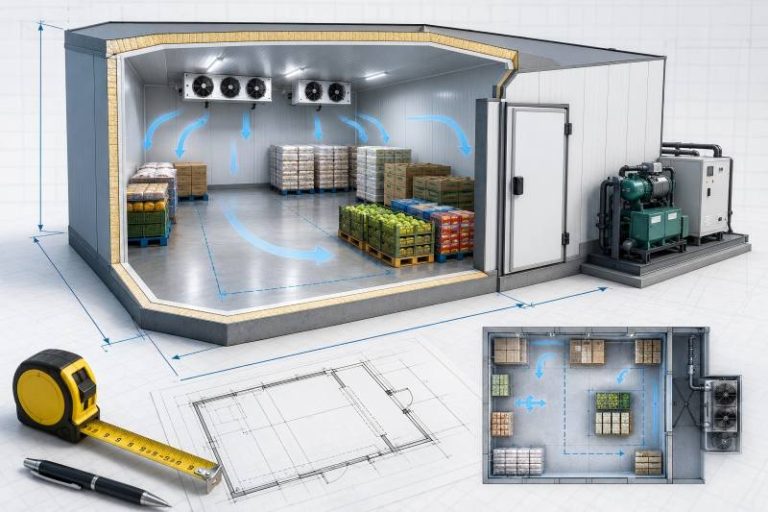
Planning ai chiller room nvolves more than selecting a room size. In actual projects, improper sizing often leads to unstable temperatures or unnecessary costs.
If the room is too small, it may struggle to maintain the required temperature. If it is oversized, both initial investment and energy consumption increase.
This guide explains a practical method to estimate chiller room size, storage capacity, and refrigeration capacity.
What Is a Chiller Room Used For?
A chiller room is typically used for storing products at temperatures above freezing, usually between 0°C and 10°C.
Common applications include:
-
Food storage
-
Meat and seafood chilling
-
Fruits and vegetables
-
Dairy products
-
Beverage storage
-
Pharmaceutical storage
-
Restaurants, supermarkets, and processing plants
Different products require different airflow, humidity, and cooling speeds, which directly affect the design.
Key Factors That Affect Chiller Room Size
Several operational factors influence the required size:
-
Product type
-
Storage volume
-
Storage temperature
-
Incoming product temperature
-
Cooling time
-
Storage method (pallets or shelves)
-
Air circulation space
-
Door opening frequency
-
Insulation performance
Step 1: Estimate Storage Capacity
Start by determining how much product needs to be stored.
Formula:
Storage Capacity = Daily Volume × Storage Days
Example:
2 tons/day × 3 days = 6 tons
It is recommended to add a 10–20% safety margin.
Step 2: Storage Density Reference
Storage density varies depending on product type and packaging.
Storage Density Table
| Product Type | Typical Density (kg/m³) | Notes |
|---|---|---|
| Fresh vegetables | 250–400 | Requires good airflow |
| Fruits | 300–500 | Avoid overstacking |
| Meat products | 350–600 | Cartons or racks |
| Seafood | 400–700 | May include ice |
| Dairy products | 350–550 | Stable temperature required |
| Beverages | 500–800 | High-density storage possible |
| Packaged food | 400–650 | Depends on packaging |
For general use, 400–600 kg/m³ is a practical estimate.
Step 3: Calculate Chiller Room Volume
Use the following formula:
Room Volume = Product Weight ÷ Storage Density
Example:
6,000 kg ÷ 500 kg/m³ = 12 m³
This is net storage volume. Additional space is required for:
-
Air circulation
-
Walkways
-
Equipment
-
Pallets or shelves
Apply a factor of 1.3–1.8:
12 × 1.5 = 18 m³
Step 4: Determine Room Dimensions
Room dimensions are calculated as:
Volume = Length × Width × Height
Example:
3 m × 2.5 m × 2.4 m ≈ 18 m³
Recommended Room Size by Capacity
| Product Quantity | Room Volume (m³) | Example Size (m) | Application |
|---|---|---|---|
| 1 ton | 4–8 | 2 × 2 × 2 | Small storage |
| 3 tons | 10–18 | 3 × 2.5 × 2.4 | Restaurant / small factory |
| 5 tons | 18–30 | 3.5 × 3 × 2.8 | Food processing |
| 10 tons | 35–60 | 5 × 4 × 3 | Medium industrial |
| 20 tons | 70–120 | 8 × 5 × 3 | Large facility |
Typical room height ranges from 2.4 m to 4.5 m, depending on application.
Step 5: Estimate Cooling Capacity
Cooling capacity depends on total heat load, including:
-
Heat transfer through walls
-
Product heat load
-
Air infiltration
-
Internal heat sources
Cooling Capacity Reference Table
| Room Volume (m³) | Cooling Capacity (kW) | Typical Application |
|---|---|---|
| 10–20 | 1.5–3 | Small restaurant |
| 20–50 | 3–6 | Food shop / small processing |
| 50–100 | 6–12 | Medium processing |
| 100–200 | 12–25 | Industrial cold storage |
| 200–500 | 25–60 | Large warehouse |
These values are for estimation only. Actual selection depends on operating conditions.
Example Calculation
Project details:
-
Product: vegetables
-
Quantity: 5,000 kg
-
Storage temperature: 5°C
-
Incoming temperature: 20°C
-
Density: 350 kg/m³
Step 1: Volume
5,000 ÷ 350 = 14.3 m³
Step 2: Adjusted volume
14.3 × 1.6 = 23 m³
Step 3: Room size
3.5 × 2.5 × 2.8 ≈ 24.5 m³
Step 4: Cooling capacity
Estimated 3–5 kW
Higher capacity required for faster cooling
Design Parameter Reference
Typical Chiller Room Design Values
| Parameter | Recommended Range | Notes |
|---|---|---|
| Temperature | 0–10°C | Depends on product |
| Room height | 2.4–4.5 m | Based on application |
| Insulation thickness | 75–100 mm | Thicker for hot climates |
| Space factor | 1.3–1.8 | Includes airflow and operation |
| Air circulation space | ≥30% of volume | Prevents hot spots |
| Door usage | Depends on operation | Use curtains if frequent opening |
Practical Design Tips
Airflow Management
Do not fully pack the room. Leave space between products and walls to allow proper air circulation.
Reduce Heat Gain
Use strip curtains or fast doors if the room is accessed frequently.
Insulation Selection
Good insulation reduces energy consumption and improves system stability.
Plan Ahead
Allow extra capacity if future expansion is expected.
Common Mistakes to Avoid
-
Calculating only floor area instead of volume
-
Ignoring incoming product temperature
-
Underestimating door opening frequency
-
Selecting equipment without load calculation
-
Poor airflow planning
These issues often result in higher costs and unstable performance.
Conclusion
Accurate chiller room sizing requires balancing storage capacity, airflow, and refrigeration performance.
A well-designed system improves efficiency, reduces operating costs, and ensures product quality.
Need Help with Your Cold Room Project?
We provide customized chiller room solutions based on your specific storage and application requirements.
Post time:Sep-25-2020
