How Does a Cold Room Work?
Introduction to the Question
In modern society, cold rooms have become an indispensable part of industrial production, food preservation, pharmaceutical storage, and logistics and transportation. From the fresh fruits and vegetables on supermarket shelves to the vaccines and biological samples in medical laboratories, from the frozen meat in food processing plants to the special chemicals in industrial workshops, all rely on cold rooms to maintain a stable low-temperature environment to ensure product quality and extend storage life. Essentially, a cold room is a specially designed, temperature-controlled enclosed space that achieves long-term low-temperature storage by artificially controlling heat transfer. Unlike ordinary household refrigerators, cold rooms have the characteristics of large space, adjustable temperature range, high stability, and strong load-bearing capacity, which can meet the large-scale storage needs of different industries.
Many people may have seen cold rooms in supermarkets, warehouses, or hospitals, but few understand the core principles behind their operation. How can a huge enclosed space maintain a constant low temperature for a long time? What key components are needed to support the operation of a cold room? How does the cold air circulate and how is the temperature precisely controlled? These are the core issues that this article aims to answer. With the continuous development of cold chain technology, the application scope of cold rooms is expanding, and understanding their working principles is not only helpful for daily use and maintenance but also for better recognizing the important role of cold rooms in the supply chain and industrial production.
This article will systematically explain the working principle of cold rooms, starting from the basic composition of cold rooms, deeply analyzing the operation mechanism of the refrigeration system, supplemented by specific data and practical cases, and answering common questions in the use process, to help readers fully understand how cold rooms work.
Detailed Explanation
The working principle of a cold room is based on the basic laws of thermodynamics, mainly through the refrigeration system to transfer the heat inside the cold room to the outside environment, thereby maintaining a stable low-temperature state inside the room. The entire working process involves the coordination of multiple components, including the refrigeration system, insulation structure, air circulation system, and temperature control system. Each part plays a key role, and the organic combination of all parts ensures the efficient and stable operation of the cold room.
1. Core Components of a Cold Room
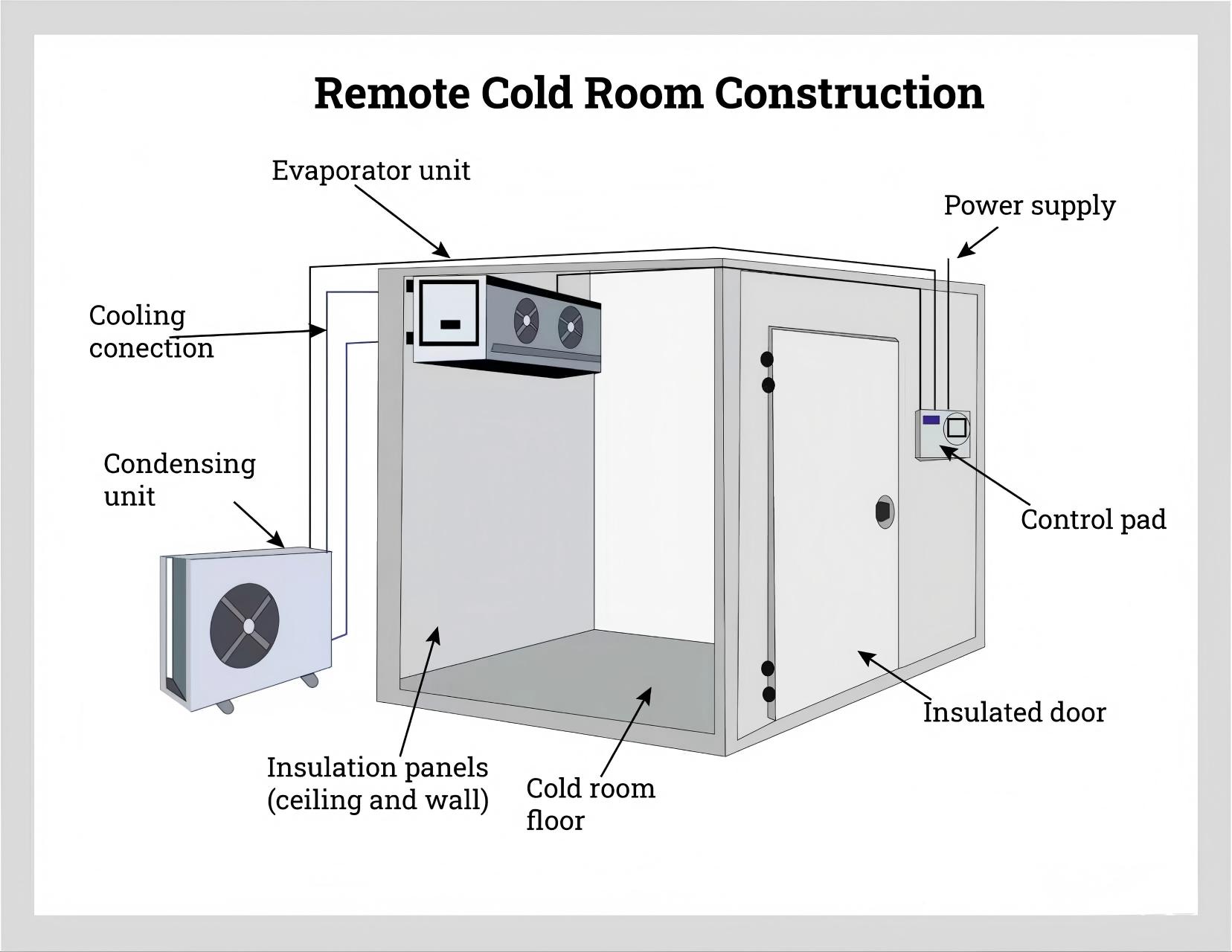
Before understanding the working process, it is necessary to first clarify the core components of a cold room, which are the foundation of its operation. The main components include the refrigeration system, insulation structure, air circulation system, temperature and humidity control system, and auxiliary components such as defrosting systems and safety devices.
The refrigeration system is the "heart" of the cold room, responsible for generating cold energy and transferring heat. Its core components include compressors, condensers, expansion valves, and evaporators. The compressor is the power source of the refrigeration system, which compresses low-temperature and low-pressure refrigerant gas into high-temperature and high-pressure gas, providing power for the entire refrigeration cycle. The condenser is used to cool the high-temperature and high-pressure refrigerant gas, converting it into high-pressure liquid. The expansion valve acts as a throttling device, reducing the pressure and temperature of the high-pressure liquid refrigerant to form a low-temperature and low-pressure gas-liquid mixture. The evaporator is installed inside the cold room, where the low-temperature and low-pressure refrigerant absorbs the heat inside the cold room and evaporates into gas, thereby reducing the indoor temperature.
The insulation structure is the "protective layer" of the cold room, which is used to reduce the heat transfer between the inside and outside of the cold room, ensuring that the cold energy inside the room is not easily lost and the external heat is not easily entering. The common insulation materials include polyurethane foam (PU), polystyrene foam (EPS), and rock wool. These materials have excellent thermal insulation performance, low thermal conductivity, and good moisture resistance. The insulation structure of the cold room includes walls, ceilings, floors, and doors. All parts need to be tightly sealed to avoid cold air leakage and heat intrusion, which is crucial to improving the refrigeration efficiency and reducing energy consumption.
The air circulation system is responsible for uniformly distributing the cold air generated by the evaporator in the cold room, ensuring that the temperature in each corner of the room is consistent. It mainly includes fans, air ducts, and air distribution plates. The fans drive the air flow, so that the cold air from the evaporator flows through the entire cold room, absorbs the heat of the stored goods and the indoor air, and then returns to the evaporator to be cooled again, forming a continuous air circulation. The rational design of the air circulation system can avoid local temperature differences, prevent the goods from freezing or spoiling due to uneven temperature, and improve the storage quality.
The temperature and humidity control system is the "brain" of the cold room, which is used to monitor and adjust the temperature and humidity inside the room in real time. It mainly includes temperature sensors, humidity sensors, controllers, and actuators. The sensors collect the temperature and humidity data inside the room in real time and transmit them to the controller. The controller compares the collected data with the set values. If the temperature or humidity exceeds the set range, the controller will issue instructions to adjust the operation of the refrigeration system, fans, or humidifiers/dehumidifiers to ensure that the indoor temperature and humidity remain stable within the required range.
In addition, the cold room is also equipped with a defrosting system and safety devices. The defrosting system is used to remove the frost layer on the surface of the evaporator. Due to the low temperature of the evaporator, the water vapor in the air will condense and freeze on its surface, forming a frost layer. The thickening of the frost layer will reduce the heat exchange efficiency of the evaporator, affect the refrigeration effect, and even damage the equipment. Common defrosting methods include electric defrosting, hot gas defrosting, and water defrosting. Safety devices include pressure relief valves, emergency stop buttons, temperature alarms, etc., which are used to prevent equipment failures and ensure the safe operation of the cold room.
2. The Working Process of the Refrigeration Cycle
The core of the cold room's work is the refrigeration cycle, which is a continuous process of compressing, condensing, throttling, and evaporating the refrigerant, thereby realizing the transfer of heat from the inside of the cold room to the outside. The specific working process can be divided into four stages:
First, the compression stage. The compressor starts to work, inhaling the low-temperature and low-pressure refrigerant gas from the evaporator. Through the mechanical compression of the compressor, the volume of the refrigerant gas is reduced, the pressure and temperature are significantly increased, and finally, the high-temperature and high-pressure refrigerant gas is discharged. This stage is the process of converting mechanical energy into the internal energy of the refrigerant, which provides power for the subsequent heat release and cooling. The performance of the compressor directly affects the efficiency and stability of the refrigeration system. Common types of compressors include piston compressors, scroll compressors, and screw compressors. Piston compressors have high reliability and can adapt to harsh working environments, while scroll compressors have the advantages of high efficiency, low noise, and low vibration, and are widely used in modern cold rooms.
Second, the condensation stage. The high-temperature and high-pressure refrigerant gas discharged from the compressor enters the condenser. The condenser is usually installed outside the cold room and is in contact with the external air or cooling water. Through heat exchange, the refrigerant gas releases a large amount of heat to the external environment, and its temperature gradually decreases, eventually condensing into a high-pressure liquid refrigerant. In the condensation process, the cooling medium (air or water) plays a role in taking away the heat of the refrigerant. For air-cooled condensers, fans are used to accelerate the flow of air, improving the heat exchange efficiency; for water-cooled condensers, cooling water is used to absorb the heat of the refrigerant, and the heated cooling water is cooled by a cooling tower and then recycled. In addition, the condenser is also equipped with a liquid receiver, which is used to store the condensed liquid refrigerant and balance the refrigerant flow in the system, ensuring the stability of the refrigeration cycle.
Third, the throttling stage. The high-pressure liquid refrigerant from the condenser enters the expansion valve. The expansion valve is a throttling device with a narrow flow channel. When the high-pressure liquid refrigerant passes through the expansion valve, the pressure suddenly decreases, and the volume expands rapidly, converting into a low-temperature and low-pressure gas-liquid mixture. At the same time, the temperature of the refrigerant drops sharply, reaching a temperature lower than the set temperature of the cold room, laying the foundation for the subsequent evaporation and heat absorption. The expansion valve can also adjust the flow of the refrigerant according to the load of the cold room, ensuring that the refrigeration system adapts to the changes in the indoor heat load and maintains stable refrigeration efficiency. Common types of expansion valves include thermal expansion valves and electronic expansion valves. Thermal expansion valves adjust the opening degree according to the temperature of the refrigerant at the outlet of the evaporator, while electronic expansion valves are controlled by the controller, which has higher adjustment accuracy and better adaptability.
Fourth, the evaporation stage. The low-temperature and low-pressure gas-liquid mixture refrigerant from the expansion valve enters the evaporator installed inside the cold room. The evaporator is usually a finned tube structure, which has a large heat exchange area. The refrigerant in the evaporator absorbs the heat of the indoor air and the stored goods, and the liquid part of the refrigerant evaporates into gas, forming low-temperature and low-pressure refrigerant gas. As the refrigerant absorbs heat, the indoor temperature gradually decreases, achieving the purpose of cooling and refrigeration. The evaporated refrigerant gas is then sucked into the compressor again, and the cycle is repeated, continuously transferring the heat inside the cold room to the outside, maintaining a stable low-temperature environment inside the cold room.
3. The Role of Insulation and Air Circulation
The insulation structure and air circulation system are important auxiliary components of the cold room, which directly affect the refrigeration effect and energy consumption of the cold room. The insulation structure prevents heat transfer between the inside and outside of the cold room. If the insulation performance is poor, the external heat will continuously enter the cold room, and the cold energy inside the room will be quickly lost, which will force the refrigeration system to work for a long time, increasing energy consumption and reducing the service life of the equipment. Therefore, the cold room must use high-quality insulation materials, and the joints of the insulation structure must be tightly sealed to avoid cold bridges and air leakage. For example, the walls and ceilings of the cold room are usually made of composite insulation panels, and the floor is laid with insulation layers and waterproof layers to prevent moisture from entering and affecting the insulation effect.
The air circulation system ensures the uniform distribution of indoor temperature. If the air circulation is not smooth, the cold air will accumulate near the evaporator, resulting in low temperature in the local area, while the temperature in other areas is too high, forming a local temperature difference. This will not only affect the storage quality of the goods but also increase the load of the refrigeration system. The air circulation system usually adopts a top supply and bottom return or side supply and side return mode. The fans blow the cold air from the evaporator to all corners of the cold room through the air ducts and air distribution plates, and the hot air after absorbing heat returns to the evaporator from the return air port to be cooled again. In addition, the air circulation system can also remove the moisture in the air, reduce the indoor humidity, and prevent the goods from being damp and moldy. For example, in the storage of fruits and vegetables, the appropriate humidity can be maintained through the air circulation system, which can extend the freshness period of the fruits and vegetables.
4. Temperature and Humidity Control Principle
Different stored goods have different requirements for temperature and humidity. For example, fresh fruits and vegetables need a low temperature of 0-10°C and a high humidity of 85-95% to slow down respiration and water loss; frozen meat needs a low temperature of -18°C or below to prevent the growth of microorganisms; vaccines and biological samples need a constant temperature of 2-8°C to ensure their activity. Therefore, the cold room must have a precise temperature and humidity control system to meet the storage needs of different goods.
The temperature and humidity control system works based on the feedback control principle. The temperature sensor and humidity sensor installed inside the cold room collect the real-time temperature and humidity data and transmit them to the controller. The controller pre-stores the temperature and humidity set values corresponding to different goods. When the collected temperature is higher than the set value, the controller issues an instruction to start the compressor and fans, and the refrigeration system starts to work, reducing the indoor temperature. When the temperature drops to the set value, the controller issues an instruction to stop the compressor, and the refrigeration system enters a standby state. If the temperature rises again, the cycle is repeated. For humidity control, if the indoor humidity is too high, the controller starts the dehumidifier to reduce the humidity; if the humidity is too low, the humidifier is started to increase the humidity, ensuring that the indoor humidity remains within the set range.
In addition, the temperature and humidity control system also has a fault alarm function. If the temperature or humidity exceeds the set range and cannot be adjusted in time, the system will issue an alarm signal to remind the staff to check the equipment, avoid the deterioration of the goods due to abnormal temperature and humidity, and ensure the safety of the stored goods.
Data and Tables
The following tables summarize the key parameters of cold rooms, including common temperature ranges, insulation material performance, refrigeration system efficiency, and energy consumption data, which can help readers better understand the working characteristics of cold rooms.
|
Cold Room Type
|
Temperature Range (°C)
|
Humidity Requirement (%)
|
Applicable Goods
|
Typical Insulation Material
|
|
|
2-8
|
85-95
|
Fruits, vegetables, dairy products, short-term preserved food
|
Polyurethane foam (PU)
|
|
Medium-temperature Cold Room
|
-2-2
|
80-90
|
Chocolate, processed food, some pharmaceuticals
|
Polyurethane foam (PU)
|
|
Low-temperature Cold Room (Freezing)
|
-15 to -25
|
90-95
|
Meat, poultry, aquatic products, long-term preserved food
|
Polyurethane foam (PU), rock wool
|
|
Ultra-low Temperature Cold Room
|
-30 to -80
|
80-90
|
Biological samples, special pharmaceuticals, scientific research materials
|
High-density polyurethane foam
|
|
Controlled Atmosphere Cold Room
|
0-10
|
80-90
|
Fruits, vegetables (extending freshness period by adjusting gas composition)
|
Polyurethane foam (PU)
|
|
Pharmaceutical Cold Room
|
0-8
|
45-65
|
Vaccines, medicines, biological products
|
Polyurethane foam (PU)
|
|
Insulation Material
|
Thermal Conductivity (W/(m·K))
|
Density (kg/m³)
|
Moisture Resistance
|
Application Scenario
|
|
Polyurethane Foam (PU)
|
0.020-0.025
|
30-50
|
Excellent
|
Most cold rooms, walls, ceilings, floors
|
|
Polystyrene Foam (EPS)
|
0.030-0.035
|
15-30
|
Good
|
Low-temperature cold rooms, auxiliary insulation
|
|
Rock Wool
|
0.035-0.040
|
100-150
|
General
|
High-temperature cold rooms, fireproof insulation
|
|
Cold Room Size (Length×Width×Height, m)
|
Cooling Capacity (kW)
|
Power Consumption (kWh/day)
|
Compressor Type
|
Daily Temperature Fluctuation (°C)
|
|
3×3×2.5
|
5-8
|
40-60
|
Scroll Compressor
|
±0.5
|
|
5×4×3
|
15-20
|
120-150
|
Scroll Compressor
|
±0.8
|
|
10×8×4
|
40-50
|
300-350
|
Screw Compressor
|
±1.0
|
|
20×15×5
|
100-120
|
700-800
|
Screw Compressor (Dual Unit)
|
±1.2
|
Note: The data in the above tables are typical values, and the specific parameters will vary according to the brand of equipment, the type of stored goods, the geographical location, and the ambient temperature. For example, in areas with high ambient temperature, the power consumption of the cold room will increase accordingly; for goods with high temperature requirements, the temperature fluctuation range will be stricter.
FAQ (Frequently Asked Questions)
Q1: What is the difference between a cold room and a household refrigerator?
A1: The core difference between a cold room and a household refrigerator lies in the scope of application, volume, and refrigeration efficiency. Household refrigerators are mainly used for small-scale storage in families, with a small volume (usually less than 1000L) and low cooling capacity. Cold rooms are designed for commercial and industrial use, with a large volume (usually more than 10m³) and high cooling capacity, which can meet the large-scale storage needs of goods. In addition, the temperature range of cold rooms is wider (from -80°C to 10°C), and the temperature and humidity control is more precise. The insulation performance and air circulation system are also more advanced, which can maintain a stable low-temperature environment for a long time. Household refrigerators are simple in structure and low in energy consumption, while cold rooms have complex components and high energy consumption, but they have stronger load-bearing capacity and adaptability.
Q2: Why does the surface of the evaporator in the cold room often have frost? How to deal with it?
A2: The surface of the evaporator has frost because the temperature of the evaporator is very low (usually below 0°C). When the humid air in the cold room comes into contact with the surface of the evaporator, the water vapor in the air will condense and freeze, forming a frost layer. The thickening of the frost layer will reduce the heat exchange efficiency of the evaporator, increase the load of the refrigeration system, and even affect the refrigeration effect. To solve this problem, the cold room is equipped with a special defrosting system. Common defrosting methods include electric defrosting, hot gas defrosting, and water defrosting. Electric defrosting uses electric heating wires to melt the frost layer; hot gas defrosting uses the high-temperature refrigerant gas discharged from the compressor to melt the frost layer; water defrosting uses warm water to rinse the surface of the evaporator to remove the frost layer. The defrosting system will automatically start according to the thickness of the frost layer (detected by the frost sensor) to ensure the normal operation of the evaporator.
Q3: How to reduce the energy consumption of the cold room?
A3: Reducing the energy consumption of the cold room can be achieved from the following aspects: First, improve the insulation performance. Use high-quality insulation materials, ensure the tightness of the insulation structure, and avoid cold air leakage and heat intrusion. Second, optimize the air circulation system. Reasonably design the layout of fans and air ducts to improve the uniformity of air circulation and reduce the energy consumption of fans. Third, adjust the temperature and humidity reasonably. Set the appropriate temperature and humidity according to the type of stored goods, avoid setting the temperature too low or the humidity too high, which will increase energy consumption. Fourth, reduce the frequency of opening and closing the cold room door. Every time the door is opened, a large amount of hot air will enter the cold room, increasing the load of the refrigeration system. Therefore, it is necessary to minimize the opening time and frequency of the door, and install air curtains or buffer rooms at the door to reduce heat intrusion. Fifth, regularly maintain the refrigeration system. Clean the condenser and evaporator regularly, check the refrigerant leakage, and ensure the efficient operation of the compressor, which can reduce energy consumption and extend the service life of the equipment.
Q4: What should I do if the temperature of the cold room cannot drop to the set value?
A4: If the temperature of the cold room cannot drop to the set value, you can check the following aspects: First, check the refrigeration system. Check whether the compressor is working normally, whether the refrigerant is insufficient (leakage), whether the expansion valve is blocked, and whether the condenser is dirty (affecting heat dissipation). If the refrigerant is insufficient, it is necessary to find the leakage point and add refrigerant; if the expansion valve is blocked, it needs to be cleaned or replaced; if the condenser is dirty, it needs to be cleaned. Second, check the insulation structure. Check whether the walls, ceiling, floor, and door of the cold room are leaking air, whether the insulation layer is damaged, and if so, repair or replace the insulation material. Third, check the air circulation system. Check whether the fan is working normally, whether the air duct is blocked, and whether the air distribution is uniform. If the fan is faulty, it needs to be repaired or replaced; if the air duct is blocked, it needs to be cleaned. Fourth, check the temperature sensor. If the temperature sensor is faulty, it will transmit incorrect data to the controller, resulting in the refrigeration system not working normally, and the sensor needs to be calibrated or replaced.
Q5: What are the common faults of cold rooms and how to deal with them?
A5: Common faults of cold rooms include compressor failure, refrigerant leakage, evaporator frosting, temperature sensor failure, and fan failure. For compressor failure: If the compressor cannot start, check the power supply, control switch, and motor; if the compressor makes abnormal noise, check whether the refrigerant is insufficient, whether the bearing is worn, or whether the compressor is overloaded. For refrigerant leakage: Find the leakage point (usually at the joints of pipelines), repair the leakage point, and add refrigerant. For evaporator frosting: Start the defrosting system to melt the frost layer, and check whether the defrosting system is working normally. For temperature sensor failure: Calibrate or replace the sensor to ensure the accuracy of temperature collection. For fan failure: Check the power supply, motor, and fan blades, repair or replace the faulty parts to ensure the normal operation of the air circulation system. If the fault cannot be solved by yourself, it is recommended to contact professional maintenance personnel for processing.
Q6: How long does it take to build a cold room? What are the main construction stages?
A6: The construction time of a cold room depends on its size, type, and installation environment. Generally speaking, a small cold room (3×3×2.5m) can be completed in 3-5 days; a medium-sized cold room (5×4×3m) takes 7-10 days; a large cold room (10×8×4m or more) takes 15-30 days. The main construction stages include: 1. Site preparation: Level the ground, install the foundation, and ensure the site meets the installation requirements. 2. Installation of insulation structure: Install insulation panels for walls, ceilings, and floors, and seal the joints. 3. Installation of refrigeration system: Install compressors, condensers, expansion valves, evaporators, and refrigerant pipelines. 4. Installation of auxiliary systems: Install air circulation systems, temperature and humidity control systems, defrosting systems, and safety devices. 5. Debugging and commissioning: Test the operation of the entire system, adjust the temperature and humidity, and ensure the cold room works normally. 6. Acceptance and delivery: Check the quality of the project, and deliver it to the user after passing the acceptance.
Conclusion
In summary, the working principle of a cold room is a comprehensive process involving thermodynamics, mechanical engineering, and electronic control. It relies on the refrigeration system to complete the cycle of compressing, condensing, throttling, and evaporating the refrigerant, thereby transferring the heat inside the cold room to the outside environment. The insulation structure ensures that the cold energy is not easily lost, the air circulation system ensures the uniform distribution of indoor temperature, and the temperature and humidity control system ensures that the indoor environment meets the storage needs of different goods. All components work together to realize the efficient and stable operation of the cold room.
With the continuous development of cold chain technology, cold rooms have been widely used in various fields such as food, medicine, logistics, and industry, playing an important role in reducing product loss, ensuring product quality, and promoting the development of the supply chain. Understanding the working principle of cold rooms is not only helpful for users to use and maintain cold rooms correctly, improve the service life of equipment, and reduce energy consumption but also for promoting the innovation and development of cold room technology. In the future, with the continuous progress of technology, cold rooms will be more intelligent, energy-saving, and environmentally friendly, providing more efficient and reliable low-temperature storage solutions for various industries.
It should be emphasized that the safe operation and maintenance of cold rooms are crucial. Regular inspection and maintenance of equipment, reasonable setting of temperature and humidity, and standardized operation can not only ensure the normal operation of cold rooms but also avoid safety accidents and economic losses. For users who need to build or use cold rooms, it is recommended to choose professional manufacturers and technical teams to ensure the quality and performance of cold rooms, and provide long-term after-sales service to solve problems encountered in the use process.
CTA (Contact Information)
If you have any questions about the design, installation, maintenance, or operation of cold rooms, or if you need to customize cold room solutions according to your needs, please feel free to contact us. Our professional team will provide you with high-quality services and technical support.
Email: info@aircoolingtech.com
Website: https://www.aircoolingtech.com/
Address: Room 308, No. 29, Lane 26, Hexuan Road, Jiading District, Shanghai.Shanghai.
We are committed to providing reliable cold room solutions for global customers, helping you reduce costs, improve efficienc
Post time:Sep-25-2020


