

1. Introduction: Why Vietnam’s Seafood Industry Demands Advanced Cold Storage
Vietnam plays a major role in the global seafood trade, especially in products such as shrimp, pangasius (catfish), squid, and tuna. Over the past ten years, demand from key export markets including the United States, European Union, Japan, and South Korea has continued to grow steadily. At the same time, many processors in the region are still facing a common limitation in their supply chain—inefficient post-harvest cold storage and temperature management.
In several coastal processing areas, seafood is still stored and handled in facilities that rely on older refrigeration systems. These systems often come with a number of practical problems in day-to-day operation, such as excessive power consumption, unstable temperature control, higher-than-expected product loss, frequent maintenance interruptions, and insufficient insulation performance.
The project discussed in this case study was implemented in southern Vietnam for a seafood processing and export company specializing in frozen shrimp and fish products. It was developed as a full cold storage upgrade rather than a partial retrofit, with the aim of addressing both operational inefficiencies and long-term energy costs.
From the beginning, the objective was straightforward: to redesign and build a more efficient cold storage system capable of cutting energy usage by around 25% while also improving temperature stability and making better use of available storage space.
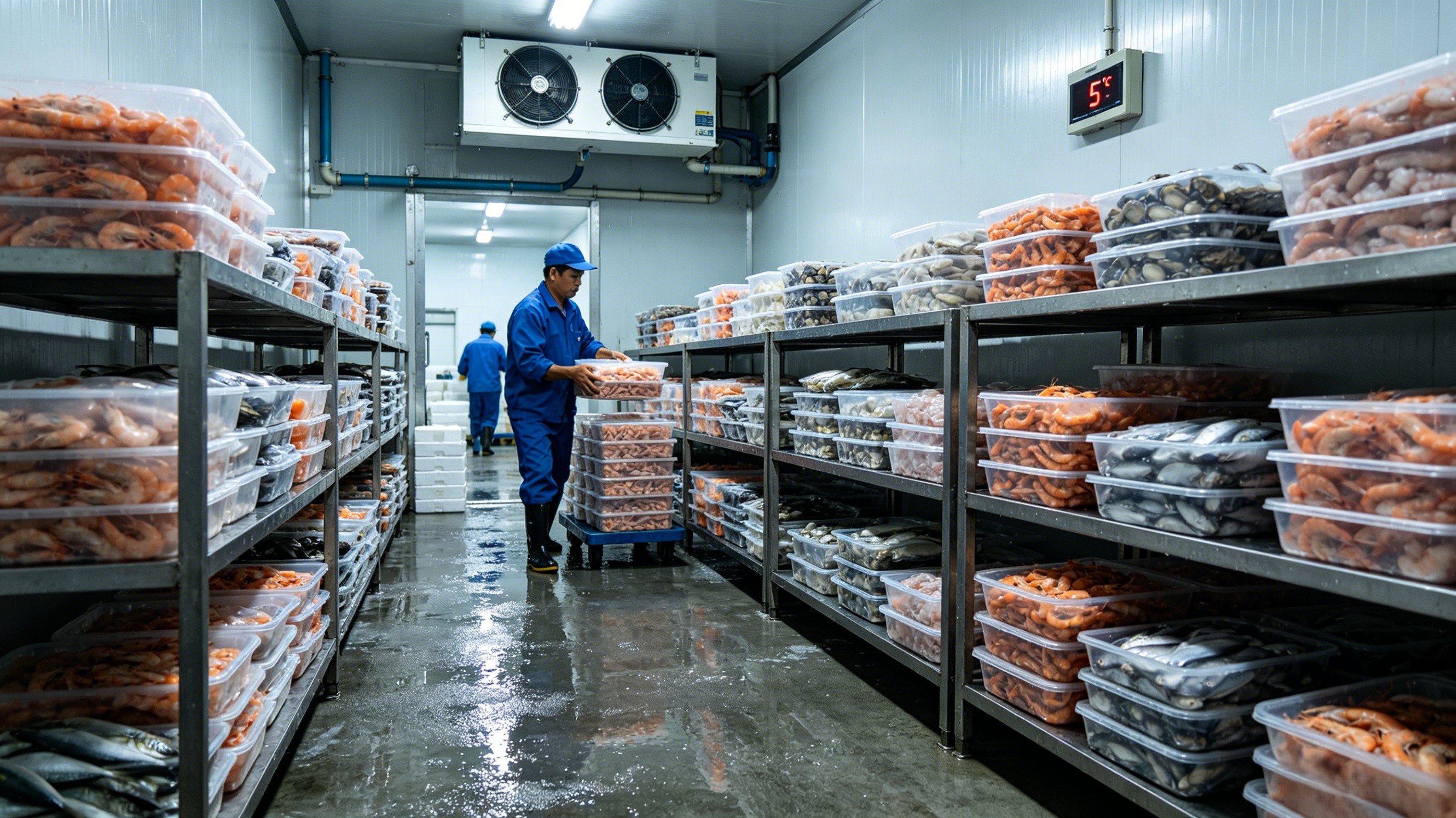
2. Project Overview
2.1 Location and Business Background
- Location: Industrial seafood processing zone, Southern Vietnam
- Industry: Seafood processing and export
- Products stored: Frozen shrimp, squid, pangasius fillets
- Storage capacity: 2,800 metric tons
- Operating temperature: -18°C to -25°C
- Daily loading capacity: 45–60 tons/day
2.2 Original Problem Statement
Before upgrading the system, the facility used a traditional cold storage setup with:
- Aging screw compressor system
- High-pressure fluctuation in refrigeration loop
- Manual defrosting cycles
- Insufficient insulation thickness (100mm PU panels only)
- Single-speed evaporator fans
Key operational issues:
- Electricity bills exceeding expectations by 30–35%
- Temperature recovery after door opening was slow (30–45 minutes)
- Product dehydration (weight loss 2–3%)
- Frequent compressor overload alarms during peak load
The client requested a full system redesign focusing on energy optimization and stability improvement.
3. Engineering Design Solution
To solve the above issues, we implemented a multi-layer energy-saving cold storage design strategy:
3.1 System Architecture Upgrade
The refrigeration system was redesigned with:
- High-efficiency screw compressor package (dual compressor system)
- Economizer-enhanced operation cycle
- Variable frequency drive (VFD) control
- Centralized PLC control system
3.2 Refrigeration Medium Optimization
The system was optimized for R507A refrigerant, chosen for:
- Stable low-temperature performance
- Better COP (Coefficient of Performance) in freezing applications
- Lower maintenance complexity compared to ammonia in small-medium systems
3.3 Cold Room Structure Upgrade
Insulation System:
- Wall panels: 150mm polyurethane (PU) high-density foam
- Roof panels: 180mm PU insulation
- Floor insulation: 150mm high-load bearing XPS + vapor barrier
Thermal Performance Improvement:
- Heat transfer coefficient reduced from 0.28 W/m²K → 0.16 W/m²K
- Estimated heat leakage reduction: ~42%
3.4 Air Distribution System
We redesigned airflow to solve uneven freezing issues:
- High-efficiency axial evaporator fans with EC motor
- Optimized air circulation path simulation (CFD-based design)
- Uniform air velocity: 2.0–2.5 m/s across storage zone
4. Energy Consumption Baseline Analysis
Before optimization, the plant recorded:
Monthly Energy Consumption:
- Average: 168,000 kWh/month
- Peak season: 190,000 kWh/month
Energy Breakdown:
- Compressors: 72%
- Evaporator fans: 12%
- Defrost system: 10%
- Auxiliary systems: 6%
Key inefficiency sources:
- Oversized compressor cycling
- Frequent start/stop operation
- Poor heat exchange efficiency
- High infiltration load from doors
5. Optimization Measures Implemented
5.1 Compressor Load Balancing System
Instead of running compressors at full load or idle mode, we implemented:
- Step-less capacity modulation
- Intelligent load distribution logic
- Real-time suction pressure control
Result:
- Reduced compressor cycling frequency by 38%
5.2 VFD Evaporator Fan Control
Traditional fixed-speed fans were replaced with EC motor fans.
Benefits:
- Adjustable airflow based on real thermal load
- Reduced unnecessary power usage during idle periods
Power savings:
- Fan energy reduced by ~42%
5.3 Smart Defrost Control
Old system: Time-based defrost (every 6 hours)
New system: Demand-based defrost using temperature differential logic
Improvement:
- Defrost frequency reduced by 28%
- Reduced heat shock to stored seafood
5.4 Cold Storage Door Optimization
A major hidden energy loss source was door infiltration.
We implemented:
- High-speed roll-up freezer doors
- Air curtain system integration
- Door opening time reduced to < 6 seconds
Result:
- Air infiltration loss reduced by 55–60%
6. Post-Implementation Energy Results
After 6 months of operation, the system stabilized and performance data was recorded.
6.1 Monthly Energy Consumption (After Upgrade)
- Average: 122,000 kWh/month
- Peak season: 135,000 kWh/month
6.2 Total Energy Reduction
| Category | Before | After | Reduction |
|---|---|---|---|
| Monthly energy | 168,000 kWh | 122,000 kWh | -27.4% |
| Peak energy | 190,000 kWh | 135,000 kWh | -28.9% |
6.3 Cost Savings
Assuming average industrial electricity cost in Vietnam:
- $0.10–0.12 USD/kWh
Monthly savings:
- Approx. 46,000 kWh saved
- ≈ $4,600–$5,500 USD/month
Annual savings:
- ≈ $55,000–$66,000 USD/year
7. Temperature Stability Improvement
One of the most important performance indicators for seafood storage is temperature consistency.
Before Upgrade:
- Temperature fluctuation: ±3.5°C
- Recovery time after door opening: 30–45 minutes
- Hot spot areas observed near loading zones
After Upgrade:
- Temperature fluctuation: ±0.8°C
- Recovery time: 10–15 minutes
- Uniform freezing environment achieved
Business impact:
- Reduced product dehydration from 2.5% → 0.8%
- Improved export-grade quality consistency
8. ROI (Return on Investment) Analysis
Total System Upgrade Investment:
- Refrigeration system upgrade
- Insulation materials
- Control system integration
- Door system upgrade
Estimated total cost:
≈ $180,000 – $220,000 USD
Annual Energy Savings:
≈ $60,000 USD average
ROI:
- Payback period: 3.0 – 3.5 years
However, when including product quality improvement and reduced loss rate:
- Additional annual benefit: ~$20,000–$35,000
- Real payback: 2.3 – 2.8 years
9. Engineering Lessons Learned
9.1 Energy loss is not only from compressors
In many seafood cold storage projects, engineers focus only on refrigeration units. However, this project confirmed that:
Door systems, insulation thickness, and airflow design contribute more than 40% of total energy loss.
9.2 System stability is more important than peak efficiency
A slightly lower COP system with stable operation performed better than a high COP system with frequent fluctuations.
9.3 Seafood product quality depends on micro-temperature control
Even ±1°C improvement significantly reduces:
- Ice crystal formation
- Tissue damage
- Weight loss during storage
9.4 Smart control systems are now essential, not optional
Manual operation leads to inconsistent performance. PLC-based automation improved:
- Energy efficiency
- Operational consistency
- Maintenance predictability
10. Conclusion
This Vietnam seafood cold storage project demonstrates how modern engineering design can transform a traditional refrigeration warehouse into a high-efficiency, stable, and cost-optimized cold chain facility.
By combining:
- Advanced compressor control
- Improved insulation system
- Smart defrost logic
- High-speed door integration
- Airflow optimization
The project achieved:
- ~27% energy reduction
- Improved temperature stability (±0.8°C)
- Significant product quality improvement
- ROI within 3 years
11. Final Insight
For seafood exporters in Southeast Asia, cold storage is no longer just a storage facility—it is a critical profit protection system.
Every 1% improvement in energy efficiency and product retention directly translates into measurable export profit.
Post time:Sep-25-2020
