

Anyone who has worked around cold storage facilities for a few years knows that doors are often overlooked during the planning stage. Most project discussions focus on refrigeration units, insulation panels, or temperature control systems. The door is usually treated as a secondary component.
In reality, that assumption can become expensive.
I have seen cold storage operators invest hundreds of thousands of dollars in refrigeration equipment while continuing to lose efficiency because the wrong door type was installed. In one frozen food warehouse project, forklifts were constantly waiting for a manually operated hinged door to close. The result was not only workflow delays but also noticeable temperature fluctuations during busy loading periods.
On another project, a small restaurant owner considered installing an industrial sliding freezer door simply because it looked more advanced. After reviewing the operation, it became clear that a standard hinged cold room door would achieve the same result at a much lower cost.
These examples highlight an important fact: there is no universal "best" cold room door.
The right choice depends on how the facility operates, how often the room is accessed, what products are stored, and how much importance is placed on long-term energy savings.
This article is based on practical industry observations, customer case studies, and operational data collected from different cold storage environments. Rather than focusing only on technical specifications, we will examine how sliding and hinged cold room doors perform in real-world conditions and where each option delivers the greatest value.
Understanding Cold Room Door Types
Before comparing the two options, it is important to understand how each door operates.
What Is a Sliding Cold Room Door?
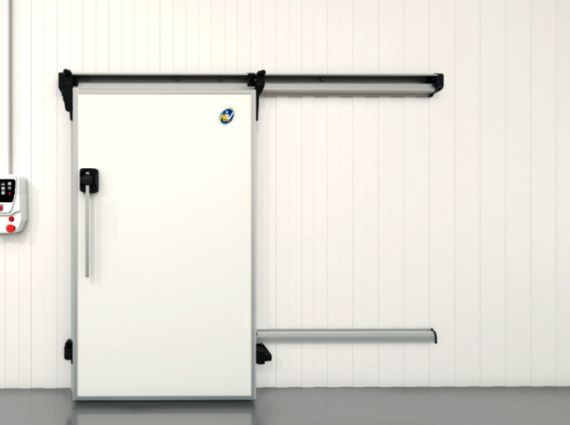
A sliding cold room door moves horizontally along a track system. Instead of swinging open, the door panel slides parallel to the wall.
These doors are commonly found in:
- Large cold storage warehouses
- Distribution centers
- Food processing plants
- Logistics hubs
- Industrial freezers
Key characteristics include:
- Space-saving design
- Larger opening dimensions
- Excellent sealing performance
- Compatibility with automation systems
What Is a Hinged Cold Room Door?
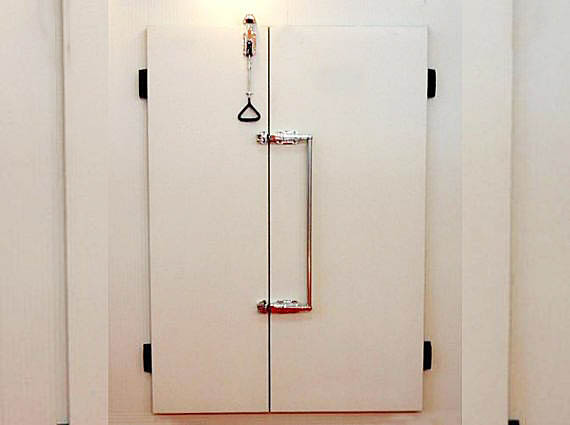
A hinged cold room door operates similarly to a standard door, opening inward or outward using hinges mounted on one side.
They are commonly used in:
- Small walk-in coolers
- Restaurants
- Supermarkets
- Pharmaceutical storage rooms
- Hotel cold rooms
Typical features include:
- Lower initial cost
- Simpler installation
- Easy maintenance
- Suitable for low-traffic environments
Industry Trends and Market Data
According to various cold chain industry reports, global cold storage capacity has expanded rapidly due to increasing demand for frozen foods, pharmaceuticals, and temperature-sensitive products.
Industry surveys indicate that:
- Energy costs account for approximately 60–80% of total cold storage operating expenses.
- Door openings contribute to up to 25% of refrigeration energy loss.
- Facilities with high traffic frequency can experience temperature fluctuations exceeding 5°C when door systems are poorly selected.
These figures highlight why choosing the correct door type can have a measurable impact on profitability.
Space Utilization Comparison
Sliding Doors
One of the biggest advantages of sliding cold room doors is space efficiency.
Since the door slides along the wall, no swing clearance is required.
Benefits include:
- More usable storage area
- Easier forklift operation
- Improved logistics flow
- Better pallet handling
Example
A frozen seafood warehouse in Southeast Asia upgraded from hinged doors to sliding doors during a facility expansion.
Results:
- 12% increase in usable storage space
- Faster forklift movement
- Reduced congestion near loading areas
The warehouse estimated annual productivity gains of approximately 8%.
Hinged Doors
Hinged doors require adequate swing space.
In smaller cold rooms, this may not be a problem. However, in larger warehouses, swing areas can reduce available storage capacity.
Challenges include:
- Restricted pallet movement
- Additional safety concerns
- Less efficient traffic flow
For facilities handling large pallet loads, hinged doors can become operational bottlenecks.
Energy Efficiency Analysis
Energy efficiency is often the deciding factor when comparing door types.
Sliding Door Performance
Modern sliding cold room doors typically feature:
- Heavy-duty insulation cores
- Compression sealing systems
- Automated closing mechanisms
- Heated frames for freezer applications
Because of their strong sealing capability, sliding doors generally minimize air leakage.
Case Study
A meat processing facility operating at -25°C replaced six aging hinged freezer doors with insulated sliding doors.
After 12 months:
- Energy consumption decreased by 11.7%
- Frost formation reduced significantly
- Compressor runtime decreased
The project achieved payback within 24 months.
Hinged Door Performance
High-quality hinged doors can also provide excellent insulation.
However, performance often depends on user behavior.
Common issues include:
- Doors left open accidentally
- Seal wear over time
- Improper closing
In low-traffic environments, these issues may be minimal.
In high-traffic facilities, they can substantially increase refrigeration loads.
Traffic Flow and Operational Efficiency
High-Traffic Operations
Facilities handling hundreds of daily entries benefit greatly from sliding doors.
Examples include:
- Food distribution centers
- Logistics warehouses
- Frozen food factories
Advantages:
- Faster access
- Forklift-friendly design
- Reduced waiting time
- Automation compatibility
Low-Traffic Operations
For smaller businesses such as:
- Restaurants
- Hotels
- Convenience stores
A hinged door may be entirely sufficient.
Traffic levels are lower, making the operational advantages of sliding doors less significant.
Durability and Maintenance
Sliding Doors
Modern industrial sliding doors are designed for intensive use.
Expected lifespan:
- 10–20 years under normal conditions
Maintenance requirements:
- Track inspection
- Roller replacement
- Seal maintenance
Although maintenance is more technical, quality sliding systems are extremely durable.
Hinged Doors
Hinged doors have fewer moving parts.
Typical maintenance includes:
- Hinge lubrication
- Gasket replacement
- Latch adjustment
For smaller facilities without dedicated maintenance teams, hinged doors are often easier to manage.
Installation Cost Comparison
Cost remains an important consideration.
Hinged Door Investment
Typical advantages:
- Lower purchase price
- Faster installation
- Lower initial investment
Suitable for:
- Small businesses
- Budget-conscious projects
- Compact cold rooms
Sliding Door Investment
Higher initial costs result from:
- Track systems
- Rollers
- Automation options
- Larger insulated panels
However, long-term savings often offset the higher investment.
Many operators focus on Total Cost of Ownership (TCO) rather than purchase price alone.
Food Industry Application Example
A frozen vegetable manufacturer operating multiple production lines evaluated both door systems.
Hinged Door Section
Used in:
- Employee access rooms
- Small ingredient storage areas
Sliding Door Section
Used in:
- Production cold rooms
- Shipping zones
- Forklift-access warehouses
Results showed that matching door type to operational needs reduced annual energy costs by nearly 9%.
This demonstrates that there is no universal solution.
The best choice depends on the application.
Pharmaceutical Industry Case Study
A pharmaceutical company storing temperature-sensitive vaccines required strict temperature control.
Challenges:
- Frequent staff access
- Regulatory compliance
- Stable temperature maintenance
The company selected automatic sliding cold room doors.
Outcomes:
- Reduced temperature fluctuations
- Improved audit compliance
- Enhanced operational efficiency
The facility reported a significant reduction in temperature alarm events during the first year.
Safety Considerations
Sliding Doors
Advantages:
- Smooth operation
- Automation compatibility
- Reduced collision risk
Potential concerns:
- Track maintenance
- Operator training
Hinged Doors
Advantages:
- Simple operation
- Familiar design
Potential concerns:
- Swing path accidents
- Forklift impacts
- Improper closing
Proper installation and maintenance are critical regardless of door type.
When Should You Choose a Sliding Cold Room Door?
A sliding cold room door is usually the best option if your facility has:
- High traffic volume
- Forklift operations
- Large openings
- Freezer applications
- Automation requirements
- Long-term energy-saving goals
Typical industries include:
- Food processing
- Cold chain logistics
- Industrial freezing
- Distribution centers
When Should You Choose a Hinged Cold Room Door?
A hinged cold room door is often the better solution if you have:
- Limited budget
- Small cold rooms
- Low traffic frequency
- Simple operations
- Limited installation space requirements
Common applications include:
- Restaurants
- Hotels
- Supermarkets
- Small pharmaceutical rooms
Expert Recommendations
Based on industry experience, the decision should not be driven solely by purchase price.
Consider:
- Traffic frequency
- Energy costs
- Available space
- Temperature requirements
- Maintenance capabilities
- Long-term operating expenses
In many modern cold storage facilities, sliding doors offer the best return on investment due to their energy efficiency and operational advantages.
However, hinged doors remain highly practical and cost-effective for smaller applications.
Common Mistakes When Choosing a Cold Room Door
After working with cold storage projects in different industries, several purchasing mistakes appear repeatedly.
Mistake 1: Choosing Based Only on Purchase Price
Many buyers focus entirely on initial cost.
A cheaper door may save money today but increase energy consumption for the next ten years.
Mistake 2: Ignoring Traffic Frequency
A door that performs well in a restaurant may become a bottleneck inside a distribution warehouse.
Daily opening frequency should always be considered before selecting a door system.
Mistake 3: Underestimating Future Expansion
Many facilities grow faster than expected.
Choosing a door system that supports future automation can prevent costly upgrades later.
Mistake 4: Focusing Only on Door Size
Door performance depends on more than dimensions.
Seal quality, insulation thickness, hardware durability, and operating efficiency are equally important.
Table 1: Quick Comparison of Sliding and Hinged Cold Room Doors
| Feature | Sliding Cold Room Door | Hinged Cold Room Door |
|---|---|---|
| Opening Method | Slides horizontally along wall | Swings inward or outward |
| Initial Investment | Higher | Lower |
| Space Requirement | Minimal | Requires swing space |
| Energy Efficiency | Excellent | Good |
| Traffic Volume | High | Low to Medium |
| Forklift Access | Ideal | Limited |
| Automation Compatibility | Excellent | Limited |
| Maintenance Complexity | Medium | Low |
| Typical Lifespan | 15-20 Years | 10-15 Years |
| Best Application | Industrial Facilities | Small Cold Rooms |
Table 2: Energy Loss Analysis Based on Daily Door Openings
| Daily Door Openings | Sliding Door Estimated Energy Loss | Hinged Door Estimated Energy Loss |
|---|---|---|
| 50 Times | 100% Baseline | 108% |
| 100 Times | 100% Baseline | 115% |
| 200 Times | 100% Baseline | 123% |
| 300 Times | 100% Baseline | 132% |
| 500 Times | 100% Baseline | 145% |
Note: Figures are based on average cold storage operating conditions and may vary depending on room size, temperature and user behavior.
Table 3: Typical Application Scenarios
| Industry | Recommended Door Type | Reason |
|---|---|---|
| Frozen Food Warehouse | Sliding | Frequent forklift movement |
| Seafood Processing Plant | Sliding | Large opening required |
| Pharmaceutical Storage | Sliding | Better temperature control |
| Restaurant Walk-in Cooler | Hinged | Lower traffic volume |
| Hotel Cold Room | Hinged | Budget-friendly solution |
| Supermarket Backroom | Hinged | Easy maintenance |
| Distribution Center | Sliding | High daily access frequency |
| Meat Processing Facility | Sliding | Enhanced sealing performance |
Table 4: Five-Year Cost Comparison Example
| Cost Item | Sliding Door | Hinged Door |
|---|---|---|
| Purchase Cost | $4,500 | $2,200 |
| Installation | $800 | $500 |
| Maintenance (5 Years) | $700 | $900 |
| Estimated Energy Cost | $18,000 | $22,500 |
| Total 5-Year Cost | $24,000 | $26,100 |
Although the sliding door requires a higher upfront investment, the total cost of ownership can become lower over time due to reduced energy consumption.
Conclusion
The debate between sliding and hinged cold room doors ultimately comes down to operational requirements rather than personal preference.
Sliding cold room doors excel in large-scale, high-traffic environments where energy efficiency, workflow optimization, and temperature stability are critical. Their superior sealing performance and space-saving design make them a preferred choice for industrial cold storage facilities.
Hinged cold room doors, on the other hand, continue to provide excellent value for smaller cold rooms, restaurants, retail stores, and low-traffic storage environments. Their lower initial cost and simple maintenance make them an attractive option for many businesses.
Before making a final decision, evaluate both the immediate investment and the long-term operating costs. A properly selected cold room door can improve efficiency, reduce energy consumption, and enhance overall cold storage performance for years to come.
The best cold room door is not necessarily the most expensive one—it is the one that matches your operational needs today while supporting your growth tomorrow.
Post time:Sep-25-2020
